

Running Your First Audit
1
Go to SEO Audit
In the sidebar, go to Analysis → On-Page SEO → SEO Audit. The first time you open it for a brand, SnowSEO discovers your pages and audits your homepage automatically.
2
Discover and audit your pages
SnowSEO finds your pages the same way Google does, and in the same order of preference:
robots.txt- we read yourSitemap:directives first.- Your sitemaps - including sitemap indexes, nested child sitemaps, and compressed
.xml.gzfiles. XML, plain-text and RSS/Atom sitemaps are all supported. - Crawling from your homepage - only as a fallback, when no sitemap is found and we have no pages on record yet.
3
Review your results
Once done, you’ll see your Audit Score (0 to 100) with counts of High, Medium and Passed checks, and a full list of issues below it.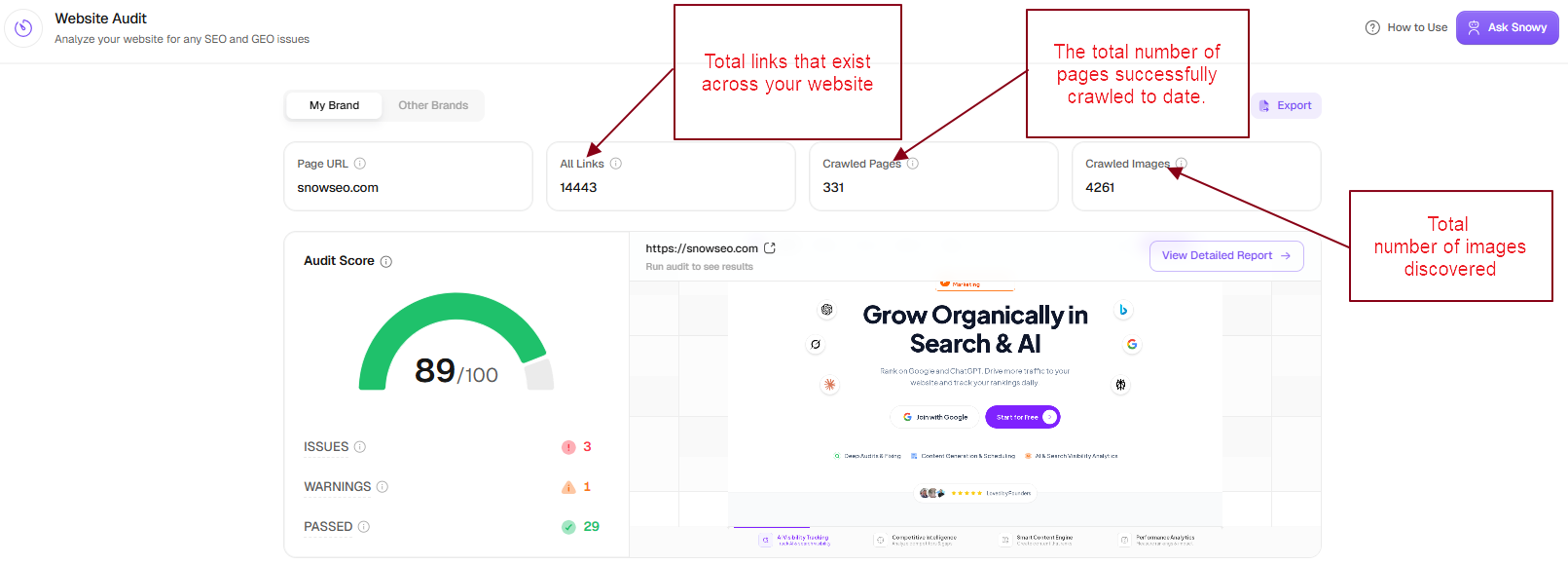
4
Explore the issues and pages
- Issues list - switch between All, High, Medium and Passed, search by name, and filter by issue type (for example Content, Metadata, Links, Images, Indexability, Security, Performance).
- Pages table - every audited page with its Technical, Content and GEO scores. Technical covers crawlability, indexing, security (HTTPS) and structure. Content covers titles, meta descriptions, headings and image alt text. GEO covers how well the page is structured for AI systems to read and cite. Open a page to see its own issues, or re-audit just that page.
- Broken Links - broken pages and links with their source pages, so you know where to fix them.
For very large sites (500,000+ pages), consider auditing during low-traffic hours like early morning. The crawler is respectful of server load by default, but it’s good practice for large-scale sites. You can also slow it down with Limit crawl speed in the audit settings.
The On-Page SEO group also has an Overview page that scans SEO, GEO, PageSpeed and Google indexing for your pages in one place, a standalone GEO Audit, PageSpeed Audit, and a Sitemap page.
Understanding Your Audit Score
Your Audit Score is a number from 0 to 100, averaged across your audited pages. Think of it like a report card for your website’s technical SEO health. The higher the number, the fewer issues Google will run into when crawling your site.Types of Issues Found
- High (Fix First)
- Medium (Fix Soon)
These are serious problems that directly prevent Google from crawling or ranking your pages. Fix these before anything else.Common issues you might see:
- Broken internal links (404) - A page on your site links to a URL that no longer exists. Visitors and search engines hit a dead end.
- Server errors (5xx) - Pages that crash when loaded. Google stops crawling these.
- Important pages blocked by robots.txt - A page that Google isn’t allowed to read.
- “noindex” on pages that should rank - A tag that tells Google to ignore the page, sometimes added accidentally.
- Redirect chains - When clicking one URL bounces through 3+ redirects before landing. Wastes crawl budget and slows users down.
Fixing Issues
Click on any issue in the report to open its detail drawer:- Which pages are affected - A list of every URL with this problem.
- Why it matters - A plain-English explanation of how it impacts your rankings.
- How to fix it - Step-by-step instructions you can hand off to a developer, plus a Copy Prompt option to paste into your AI assistant.
- Re-audit pages - Re-check just the pages affected by this issue after you fix it, without a full re-audit.
- Mark as Fixed - Mark one page, or Mark All as Fixed, to track your progress.
- Fix / Fix All Pages - Let SnowSEO apply the fix for you (see below).
Auto-fix (WordPress)
If your WordPress site is connected, SnowSEO can write some fixes directly to your site. A confirmation dialog shows the credit cost, lets you add optional Custom instructions (for example “keep the brand name at the end of every title”), and applies the change when you click Fix now.
Custom instructions add a small extra charge based on their length. A fix runs only when you confirm it, and you can review what changed on each page afterwards. PageSpeed issues have their own fixes, covered below.
Setting a Recurring Audit Schedule
Running audits once isn’t enough - your site changes constantly. Turn on Always-On Audit so SnowSEO re-crawls your site automatically and surfaces new issues for you. You can flip it from the Audit Now dropdown, or from settings. Open the user menu at the bottom-left, then Settings → Automation → Audit, toggle Always-On Audit on, and choose a frequency: Every day, Twice every day, Every other day, Every 3 days, Every 7 days, or Every 14 days. The cadence available depends on your plan. In the same panel you can also set:- Subdomains - extra hosts to include (your primary domain is always included).
- Selected sitemaps - the sitemaps used to discover pages.
- Excluded URLs - full page URLs to skip entirely (use Bulk add to paste several, one per line).
- Limit crawl speed - slow the crawl for small or shared hosting, with Requests at a time and Delay between requests.
The Configure settings item in the overflow menu on the SEO Audit page jumps straight to this panel.
Submitting Pages for Indexing
Connect IndexNow in Integrations → SEO, then use Submit for Indexing in the overflow menu on the SEO Audit page to push pages to participating search engines (such as Bing and Yandex) right away. Choose Submit All Pages or Submit Selected Pages. Turn on Auto-Indexing (here or in Settings → Automation → Audit) and SnowSEO checks daily and submits new and updated pages for you. If you have Google Search Console connected, the Overview page can also check each URL’s indexing status with Google. Each status explains what Google found and what to do about it, for example crawled but not indexed, blocked, or duplicate content.Auditing Other Brands
Switch the My Brand toggle to Other Brands, enter a URL (for example a competitor), and click Analyze SEO to see how another site scores and export the result as a PDF.PageSpeed Audit
PageSpeed Audit is a separate page in the On-Page SEO group. It runs Google PageSpeed Insights across your crawled pages and groups Lighthouse issues site-wide.To use it, you need both: (1) at least one SEO Audit crawl completed, and (2) the Google PageSpeed Insights integration connected in Integrations → SEO.
How to Access
- In the sidebar, go to Analysis → On-Page SEO → PageSpeed Audit
- Choose your strategy: Desktop or Mobile (one at a time - Desktop is the default)
What You Get
- An overall PageSpeed Score gauge with High / Medium / Passed counts
- Category scores for Performance, Accessibility, Best Practices, and SEO
- Core Web Vitals for LCP, CLS, and INP
- Grouped Lighthouse issues with severity and affected-page counts
- A per-page table with a detail drawer - run a single URL on demand from its row
Running Tests
Click Audit Now and choose Test All Pages or Test Selected Pages. The same dropdown has an Always-On Page Speed toggle (on by default) that automatically re-runs pages in the background. Set its frequency in Settings → Automation → Audit. For WordPress sites, some PageSpeed issues can be fixed for you, per page or site-wide (for example image dimensions, text compression, caching and render-blocking resources). Most are free, a few cost 1 credit.Mobile vs Desktop
The strategy toggle updates all metrics and issues for the selected device class. PageSpeed runs do not use up your monthly SEO audits.Frequently Asked Questions
Will the audit crawler slow down my website for real visitors?
Will the audit crawler slow down my website for real visitors?
No, not meaningfully. SnowSEO sets a conservative crawl rate by default - it won’t hammer your server. If you’re on small shared hosting, turn on Limit crawl speed in Settings → Automation → Audit to slow it further.
My score dropped and I didn't change anything - why?
My score dropped and I didn't change anything - why?
A few things can cause this without you touching the site:
- An external site you link to went down (creating a broken outbound link)
- A third-party script or image got removed, creating a missing resource error
- Our scoring was refined to better reflect current Google guidelines
I fixed some issues - when will my score update?
I fixed some issues - when will my score update?
Re-audit the affected pages. Use Re-audit pages inside an issue, or Audit Now → Audit Selected Pages. Each audit is a fresh check of the page, so your score reflects the changes right away.
What's the difference between a redirect chain and a redirect loop?
What's the difference between a redirect chain and a redirect loop?
A redirect chain is when URL A → B → C → D (more than one hop). This wastes Google’s crawl budget and loses some “link juice” at each step. A redirect loop is when URL A → B → A (they redirect to each other indefinitely), which means the page simply never loads.
There are 200+ issues - where do I start?
There are 200+ issues - where do I start?
Start with High issues only, and fix the ones affecting the most pages first. Once those are cleared, move to Medium. You don’t need to fix every low-impact item - those are optional improvements.
Can I exclude certain pages from the audit?
Can I exclude certain pages from the audit?
Yes. Open Settings → Automation → Audit and add the full page URLs you want to skip to the Excluded URLs list (e.g.,
https://yoursite.com/blog/drafts/). Use Bulk add to paste several at once. The crawler will skip those URLs entirely.