



Sites that use topic clusters consistently outrank sites that publish random individual articles. It’s one of the most powerful long-term SEO moves you can make.
How Topical Authority Works
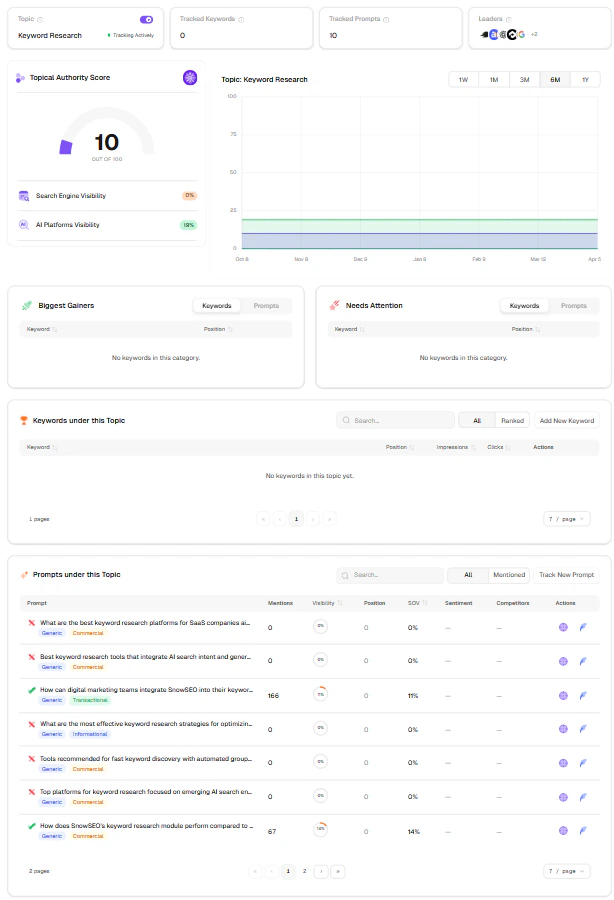
The Topical Authority dashboard helps you measure one topic from discovery to improvement. The most important components are:- Top summary bar Shows the topic name, tracked keywords count, tracked prompts count, and competing leaders. This tells you if tracking is set up correctly before analyzing performance.
- Topical Authority Score card A 0-100 score that summarizes topic strength, plus split visibility indicators for search engines and AI platforms. Use this as your headline KPI for the topic.
- Trend chart (1W, 1M, 3M, 6M, 1Y) Visualizes topic performance over time. Use longer ranges (3M-6M) to judge strategy impact and shorter ranges (1W-1M) to spot recent changes.
- Priority panels: Biggest Gainers and Needs Attention These panels quickly show which keywords or prompts are improving and which are stagnating or slipping, so you know where to act first.
- Keywords under this Topic Your operational keyword table with core metrics (position, impressions, clicks, and actions). Use it to decide which keyword pages to optimize next.
-
Prompts under this Topic
Tracks prompt-level visibility and mentions, including prompt intent and competitor context. This is where you monitor GEO performance and
identify prompts where competitors are being cited more than your brand.
Creating a Topic in SnowSEO
Go to Topical Authority
In the sidebar, click Planning → Topic Topical Authority, then click + New Cluster.
Choose your pillar keyword
Enter a broad keyword that represents the main topic. This is what your pillar page will target.
Add cluster keywords
Enter the more specific, long-tail keywords that will become your cluster pages. SnowSEO can suggest ideas from its research database if you need inspiration.
Map to existing content
For each keyword, either link to a page you’ve already written, or mark it as Planned (not written yet). This instantly shows you your content gaps.
Tracking Your Topic’s Performance
Instead of just watching individual keyword rankings, SnowSEO shows you how the whole cluster is performing:Cluster Visibility Score
A combined score based on all keyword positions within the cluster. Rising score = your topical authority is growing.
Coverage Gaps
Sub-topics in your cluster that don’t have a published page yet. These are your highest-priority content opportunities.
Internal Link Health
Checks whether all cluster pages link back to the pillar and vice versa. Missing links = missed authority signals.
Cluster Traffic
Total organic sessions across all pages in the cluster (requires GA4). See the combined impact of a topic area, not just one page.
What Makes a Strong Topic?
📏 The pillar page needs to be comprehensive
📏 The pillar page needs to be comprehensive
Your pillar page should be the most thorough resource on the topic — not a thin overview. Aim for 2,000–5,000 words. It should answer the big question and link to cluster pages for deeper dives on each sub-topic.
🎯 Each cluster page should answer one specific question
🎯 Each cluster page should answer one specific question
Cluster pages dive deep into a single sub-topic. Avoid overlap — if two cluster pages answer the same question, merge them. Each page should serve a distinct reader intent.
🔗 Links must go both directions
🔗 Links must go both directions
The pillar links out to all cluster pages. Every cluster page links back to the pillar. Without this bidirectional linking, Google can’t recognize the relationship between your pages.
Frequently Asked Questions
How is a topic cluster different from just writing a lot of articles?
How is a topic cluster different from just writing a lot of articles?
Random articles don’t reinforce each other — each one competes in isolation. A topic cluster is intentionally structured so every piece of content strengthens the others through internal linking. Google recognizes the collective authority of the cluster, which leads to better rankings across all the keywords, not just the one you’re targeting.
How many cluster pages do I need to see results?
How many cluster pages do I need to see results?
Most clusters start producing noticeable results with 5–10 published pages (pillar + 4-9 cluster pages). The more complete your cluster, the stronger your authority signals — but even a half-built cluster performs better than disconnected articles.
Can I have the same page in multiple clusters?
Can I have the same page in multiple clusters?
Yes, but use it sparingly. A page can serve as a cluster page for two related topics if the content genuinely covers both. SnowSEO will flag it if the same URL appears in conflicting clusters, which can sometimes signal content cannibalization.
Does SnowSEO help me find what cluster keywords to target?
Does SnowSEO help me find what cluster keywords to target?
Yes. When you enter your pillar keyword, SnowSEO suggests related long-tail keywords from its database — analyzing which terms Google already groups together in search results. This ensures your cluster structure matches actual search behavior.
My pillar page is already written — can I build a cluster around it?
My pillar page is already written — can I build a cluster around it?
Absolutely. Add your existing pillar URL when you create the cluster, then add your cluster keywords. Mark existing articles as mapped, and identify the gaps. SnowSEO will also scan the existing pillar for internal linking opportunities to cluster pages.
How long does it take to see results from a topic cluster?
How long does it take to see results from a topic cluster?
Typically 2–4 months for new clusters to build meaningful visibility. Topical Authority built around topics where you already have some existing rankings can move faster — sometimes 4–6 weeks. The key is publishing consistently and ensuring all internal links are in place.