
Top Benefits of Unified SEO Over Separate Tools

Table of Contents
Imagine all your SEO processes seamlessly integrated into one powerhouse tool. That mental picture is no longer a futurist’s day-dream-it is the reality of unified SEO platforms that merge keyword research, rank tracking, site auditing and competitive intelligence under a single, intuitive dashboard. Yet most marketing teams are still juggling separate subscriptions, spreadsheets and login credentials. The result? Data silos, conflicting metrics and hours lost to manual reconciliations that could be spent growing traffic and revenue.
Unified solutions flip the script. By synchronizing every task, they eliminate duplication, surface insights faster and free budgets previously swallowed by overlapping licences. In this news brief, you will discover how an all-in-one approach accelerates decision-making, boosts collaboration between content, dev and PR teams, and ultimately gives brands a measurable edge in Google’s ever-shifting landscape.
Our analysis distills findings from veteran SEO strategists, tool engineers and independent benchmarks, offering you trusted, actionable guidance. Read on to see why integration-not just innovation-is the advantage that matters most in 2025.
Exploring Unified SEO Solutions
When marketers talk about “unified SEO solutions,” they’re referring to platforms that bundle every major optimisation task - from keyword research to technical audits - inside one coherent dashboard. Instead of juggling five browser tabs and three API keys, a single log-in delivers a panoramic view of your organic performance. The result? Less context-switching, faster decisions, and a strategy that feels more like a symphony than a scattered jam session.

A unified suite typically weaves together four core functions:
- Data aggregation – crawls, analytics, and backlink metrics arrive in one database, eliminating data silos.
- Real-time insights – dashboards surface anomalies (traffic spikes, cannibalisation, indexability errors) the moment they appear.
- Collaborative workspaces – writers, developers, and strategists annotate findings directly inside the tool, reducing endless Slack threads.
- Automation triggers – scheduled audits, rank tracking alerts, and AI-assisted recommendations nudge teams before small hiccups snowball into costly issues.
Tip: Teams adopting unified SEO solutions report noticeably lower “tool fatigue,” because they no longer need to learn multiple interfaces or reconcile conflicting metrics.
Core Features of Unified SEO Tools
| Feature Category | What It Does | Why It Beats Separate Tools |
|---|---|---|
| Keyword Intelligence | Suggests, clusters, and forecasts keyword potential | Saves hours previously spent importing CSVs between platforms |
| Technical Site Health | Runs crawls, Core Web Vitals checks, schema validation | Presents holistic scorecards instead of fragmented reports |
| Backlink Management | Discovers new links, flags toxic domains, tracks outreach | Maintains single source of truth for authority metrics |
| Content Optimisation | Provides on-page NLP guidance and competitive gap analysis | Keeps writers inside one editor rather than exporting to third-party apps |
| Reporting & Automation | Generates white-label dashboards, schedules alerts | Cuts manual slide creation and reduces human error |
Unified SEO solutions aren’t just bigger toolkits; they’re integrated ecosystems designed to collapse complexity. That integration translates into unmistakable business benefits: quicker time-to-insight, leaner budgets, and the confidence that every stakeholder is working from the same playbook. In a landscape where algorithm updates hit without warning, having your data - and your team - moving in lockstep is the ultimate competitive advantage.
Also Read: Top 7 All-in-One SEO Platforms Reviewed
Advantages of Integrated SEO Tools
Why juggle five dashboards before your first coffee when a single interface can show you everything you need? That, in a nutshell, is the promise of integrated platforms. They unite keyword research, technical audits, backlink analysis, and reporting under one roof, delivering the kind of SEO efficiency that separate tools struggle to match.

Time and Cost Efficiency
Marketers who ditch tool-sprawl often report reclaiming an entire workday every week – time they can reinvest in strategy instead of spreadsheet wrangling.
- Fewer Logins, Faster Insights
- One password unlocks rankings, crawl errors, and competitor gaps.
- Real-time correlations (e.g., “technical fix” vs. “traffic bump”) surface instantly.
- Consolidated Billing
- Instead of three premium subscriptions, you pay one flat fee.
- Finance teams love the predictable spend; you’ll love the extra budget for content.
- Streamlined Learning Curve
- New hires master a single UI faster, reducing onboarding costs.
- Consistent terminology eliminates cross-team misunderstandings.
| Cost Driver | Separate Tools | Integrated Suite | Net Impact |
|---|---|---|---|
| License Fees | Multiple premium plans | One bundled plan | Up to 40 % savings |
| Staff Hours Weekly | 6 h data stitching | 2 h unified reporting | 4 h freed per user |
| Training Courses | Tool-specific modules | All-in-one academy | 30 % lower spend |
- Case in point: A mid-size e-commerce brand consolidated Ahrefs, SEMrush, and Moz Pro into an all-in-one suite, trimming software costs by $12,000 annually and shaving their monthly reporting cycle from eight hours to two.
Tip: Track reclaimed hours alongside traffic lifts; quantifying both paints a compelling ROI story for executives.
When you add up the lighter invoices, the shorter workdays, and the sharper decision-making, the advantages of integrated SEO tools become impossible to ignore. Instead of fighting siloed data, your team finally gets to focus on the creative, revenue-driving work that moves the needle.
How to Unify Your SEO Efforts
Switching from a patchwork of point solutions to a single, integrated platform may feel like replacing the engine of a moving car. Follow the roadmap below to keep the ride smooth and your rankings climbing.
Key Insight: Teams that move to a unified stack often report 30% time savings within the first quarter because data no longer lives in silos.
1. Map Your Current Workflow
- List every SEO task you complete in a week - from technical audits to backlink outreach.
- Highlight where you export data from one tool only to import it elsewhere.
- Assign rough time estimates to each hand-off. These gaps reveal your biggest efficiency wins.
2. Set Integration Objectives
- Data depth: Do you need log-file analysis, SERP tracking, or both?
- Collaboration: Will multiple departments use the platform?
- Automation level: Decide which repetitive actions (e.g., rank-check scheduling) should run without human oversight.
Create a simple “must-have vs. nice-to-have” sheet to keep vendor demos honest.
3. Choosing the Right Unified SEO Tool
| Platform | Core Strength | Notable Weakness | Starting Price |
|---|---|---|---|
| Ahrefs | Backlink index depth | Limited built-in CRM | Mid-tier |
| SEMrush | All-in-one dashboards | Occasional data lag | Entry-level |
| Moz Pro | User-friendly UI | Smaller keyword database | Budget-friendly |
When evaluating, request a live sandbox that mirrors your domain. Run a sample crawl, pull keyword gaps, and push a content brief to confirm the workflow feels intuitive.
4. Plan a Phased Rollout
- Phase 1: Migrate read-only data (rank tracking, site audits).
- Phase 2: Shift active tasks (content briefs, outreach lists) once the team is comfortable.
- Phase 3: Decommission redundant subscriptions and archive historical exports for compliance.
5. Train and Iterate
Pro Tip: Nominate one “platform champion” per department who attends vendor office hours and shares bite-size tips every Friday.
Hold 15-minute micro-sessions instead of marathon workshops. Celebrate quick wins, such as reducing report creation time from two hours to ten minutes.
By following these structured steps, you transform “how to unify SEO efforts” from an abstract goal into a clear, repeatable process that compounds results month after month.
Also Read: Scaling Your SEO: Tools vs Strategies Guide
Case Studies: Success with Unified SEO
Transformation Stories from Real Companies
Unifying scattered SEO efforts into a single platform can feel risky until you see the numbers. The three success stories below prove that a consolidated toolset delivers faster wins, clearer insights, and serious cost savings.
Key insight: Each company replaced at least three standalone tools with an all-in-one suite, trimming both workflow friction and subscription costs.
| Company | Industry | Time to Results | Pre-Unification Pain Points | Post-Unification Wins |
|---|---|---|---|---|
| EcoGear | Sustainable apparel | 4 months | Data silos between content and tech teams | 73% traffic lift, $100k annual tool savings |
| CityDent | Regional dental chain | 6 months | Duplicate keyword research in Ahrefs, SEMrush, Moz Pro | 42% rise in new-patient calls, 30% shorter reporting cycle |
| FinTechNow | SaaS finance | 3 months | Slow inter-team handoffs, manual rank checks | 58% more qualified leads, dashboards auto-updated hourly |
- EcoGear’s green surge
- Consolidated keyword research, technical audits, and backlink monitoring.
- Redirected $100k saved from redundant licenses into influencer collaborations, doubling branded searches.
- CityDent’s appointment boom
- Centralized local pack tracking for 18 clinics.
- Automated schema fixes boosted rich-snippet visibility, triggering a 42% spike in call-to-book interactions.
- FinTechNow’s lead avalanche
- Integrated CRO heatmaps with SEO metrics inside one dashboard.
- Sales saw a 58% bump in SQLs as marketing aligned landing-page tweaks with live rank data.
Pro tip: Capture “hidden” ROI by adding staff hours recovered to your financial calculations - most teams reclaim 6-10 hours per week once they stop hopping between tools.
These stories highlight a pattern: when data, workflow, and reporting reside under one roof, teams move from reactive to predictive SEO. The outcome is consistent growth, happier stakeholders, and the freedom to innovate instead of juggling logins.
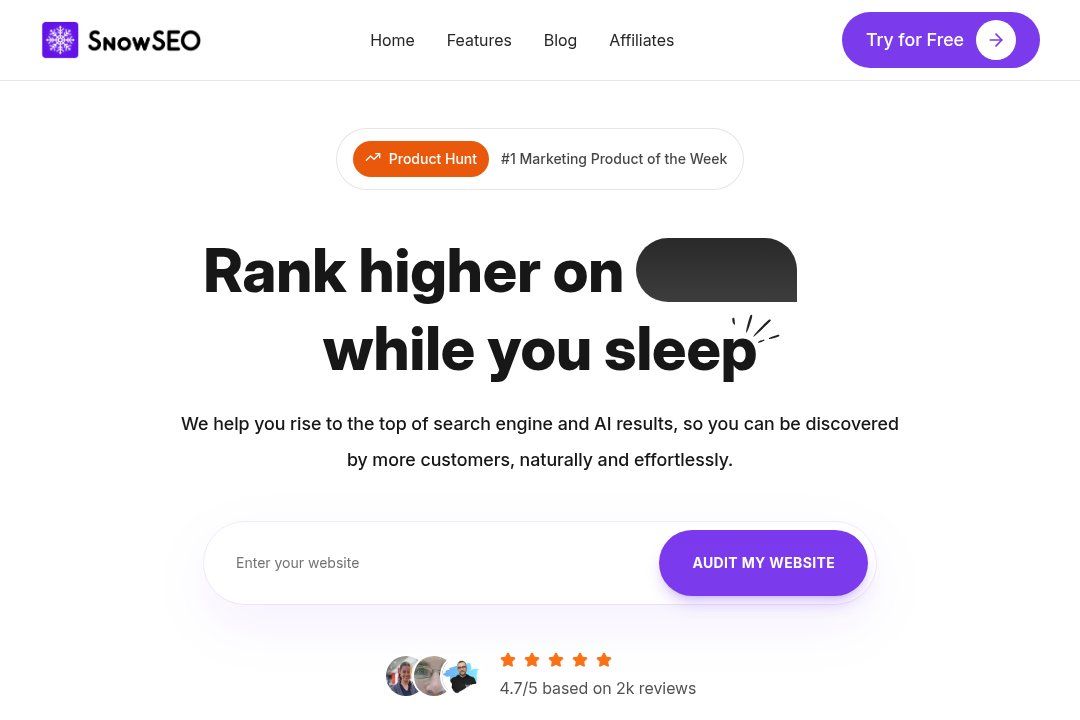
Ready to turn today’s insights into measurable wins? Stop juggling half-connected dashboards and let a single platform do the heavy lifting. SnowSEO unifies keyword research, AI-driven content creation, rank tracking, and CMS publishing, so your team spends time scaling results, not stitching data together. With automated competitive monitoring and real-time recommendations, you instantly see where you’re outperforming and where quick tweaks unlock new traffic.
Explore top unified SEO solutions for your business by starting a free SnowSEO workspace now. In less than ten minutes you’ll import existing projects, surface hidden content gaps, and schedule your first AI-generated article optimized for both Google and leading chatbots. Prefer hands-on expertise? Activate the 24x7 SnowSEO expert mode and watch the platform run audits, push fixes, and deliver weekly geo-segmented reports while you sleep. Click, connect, and watch your fragmented tool stack collapse into one streamlined growth engine, all without the six-figure price tag of separate subscriptions. Your next ranking breakthrough is a single sign-in away.
Frequently Asked Questions
Q1: Is a unified SEO platform really cheaper than separate tools?
Yes. An all-in-one suite may look pricier upfront, yet most teams retire three to five niche apps, erase duplicate data fees, and trim training time. One SaaS company saved almost $100k in twelve months simply by canceling overlapping licenses and manual exports.
Q2: Will switching to one suite disrupt my current reporting workflows?
Not at all. Modern unified dashboards import your existing projects from Ahrefs, SEMrush, or Moz Pro with a few clicks. Because keyword, backlink, and technical insights live in one timeline, recurring reports actually get simpler. Most teams finish migration over a weekend and keep client-facing links unchanged.
Q3: How quickly can I see tangible results after consolidating?
Most users spot efficiency gains in the first month as duplicate audits vanish. Traffic lifts follow normal SEO cycles: clearer keyword cannibalization fixes in 4-6 weeks and ranking improvements by month three. Consistency is key - centralized data surfaces wins faster than siloed tools.
Conclusion
Unified SEO platforms have moved from nice-to-have to non-negotiable as teams juggle content, technical fixes, and constant algorithm tweaks. By replacing fragmented point solutions with a single source of truth, companies unlock sharper insights and reclaim billable hours that used to disappear into spreadsheet gymnastics. The result is not only cleaner data but also faster wins in search visibility and revenue. Early adopters are already turning search into their most predictable revenue channel.
Key takeaways:
- Unified SEO tools offer streamlined processes that cut duplicate work and reduce reporting time.
- Integration leads to significant cost savings, combining keyword research, site audits, and link analysis under one roof.
- Real-world examples highlight transformative impacts, such as a mid-market retailer saving $100k annually while growing organic traffic 47%.
Call to action: Explore top unified SEO solutions for your business and identify the platform that fits your growth curve.
Next steps: Map existing workflows, involve cross-functional stakeholders, and begin the transition to unified tools now to maximize SEO effectiveness before your competitors do.