

SEO Strategies Every Content Creator Needs

Table of Contents
In the evolving world of digital marketing, staying ahead with the latest SEO strategies is crucial. You feel this pressure every time search results shift or a new update drops. The ground moves fast, and missing one change can push your content to page two. Nobody wants that.
Many content creators struggle to keep up with the fast-paced changes in SEO. You write strong content, but the rules shift again. Maybe your posts lose traffic. Maybe your reach stalls. It is not a skill problem. It is a pace problem.
You need clear steps that match how search works now. You also need a plan for where SEO is going next. That is why this guide focuses on future-ready SEO strategies for 2026. These ideas help your content stay visible, sharp, and built for the long game.
Industry experts and data-driven analysis point to one thing: creators who plan ahead win. About 90 percent of top marketers already shape content with future updates in mind. You can do the same with the right tools and a simple method that cuts through the noise.
The Evolution of SEO Strategies
Search keeps shifting under your feet. One year you chase keywords. The next year Google and Bing decide context and intent matter more. If you want to stay visible in 2026, you need to understand why SEO now feels closer to product design than old school optimization.
Google has pushed hard toward AI driven search. Updates like the expanded AI Overviews show how the engine now reads full intent rather than exact terms. You can see this shift in the AI Overview updates where Google explains how its models interpret meaning instead of matching phrases. Bing follows the same path. Microsoft highlights this move in its notes on how AI rewrites search behavior, as shown in the AI insights from Microsoft.
This change forces you to think deeper about your content. You can not pad pages with keywords anymore. You need to match user goals and answer the next question before they ask it.
From Keywords to Contextual Ranking
Engines now judge content by how well it solves a problem. Context beats density every time. If someone searches for best tools for ranking in 2026, the engine looks for intent signals like clarity, depth, and user value, not how often you repeat the phrase.
Treat every piece like a mini guide that solves a real pain point. You win when your content is helpful, not stuffed.
Here is how the shift looks in practice.
| Approach | What Changed | Impact in 2026 |
|---|---|---|
| SnowSEO | Uses AI to map intent, generate context rich content, and monitor rankings across search engines and AI chat platforms | Helps you match search behavior and close content gaps fast |
| Keyword stuffing | Lost value as engines moved to semantic checks | Leads to low rankings and weak engagement |
| Basic on page SEO | Needed but not enough alone | Works only when paired with context and depth |
If you want to stay ahead, build your strategy around tools that adapt. Start with SnowSEO, since it ties keyword research, AI content, and performance tracking into one workflow. Then back it up with SEMrush or Ahrefs for added competitive data.
Implementing AI in SEO for 2026
AI in SEO now decides who wins and who gets buried. You either build with it or fall behind faster than you expect. Many publishers already see a traffic drop as AI summaries take over results. That shift is clear in news on how search summaries cut publisher visibility. So you need future SEO techniques that help you show up in both search engines and AI answers.

AI-Powered Tools for SEO
AI tools now run most of the heavy lifting. The smart move is to let them handle data, trends, and content gaps so you can focus on strategy.
Start with tools that give you full automation. SnowSEO leads that group because it covers the full pipeline. You get keyword discovery, content creation, monitoring, and publishing without switching tools. It also tracks your brand inside AI answers, which helps you show up even when search engines hide links.
Here is how top tools compare:
| Tool | Key Feature | Best Use |
|---|---|---|
| SnowSEO | Full AI-SEO automation for search and AI engines | Teams that want one platform |
| SEMrush | Deep data and keyword sets | Large sites with complex audits |
| Ahrefs | Strong link and insight data | Brands focused on backlinks |
Use one primary tool so you keep your data in one place. Jumping between dashboards slows you down and breaks your workflow.
Teams that move fast follow a simple process:
- Start with SnowSEO to scan your content gaps.
- Pull keyword clusters and user intent insights.
- Build drafts with AI content tools but add your voice.
- Push content to your CMS with one click.
- Track rank shifts and AI mentions each week.
Most creators skip step five. Do not do that. You need to know when AI engines list your brand. That data shows what to fix next.
Case studies show how teams win with this setup. One brand used SnowSEO to rewrite outdated posts and saw new keywords rank in days. They also caught AI misquotes before they spread.
Publishers see AI reshape traffic patterns. Reports on search changes driven by AI overviews make that clear. You cannot wait for SEO to settle. You need tools that react fast so you stay seen across every platform.
Advanced Content Optimization Techniques
Strong content wins when you treat SEO like a long game. You need to mix smart writing with smart structure. That balance pushes you past bloggers who only chase keywords. Let’s dig into the moves that help you compete in hard niches and stay visible on both search engines and AI discovery tools.
Before we go deeper, keep one thing in mind. Advanced optimization hits harder when your workflow is built on tools that do the heavy lifting. SnowSEO leads that list. It automates keyword mapping, content scoring, AI platform optimization, and even CMS publishing. It gives you the foundation you need to compete with brands that have big SEO teams.
Leveraging Long-Form Content
Long-form content still pulls strong results. It lets you build depth and show clear expertise. Search engines read it as authority. AI engines use it as clean training context. You win both sides of the algorithm.
Recent updates like the shift to AI search explain why more depth now matters. You can see this shift in the rise of new tools and standards, like the move toward AI-ready formats mentioned in guides on creating AI optimized content. Even Google’s direction toward AI assisted search suggests that depth helps your content get pulled into answers, as seen in Google’s update on AI search modes.
Give readers something that answers the full problem. That is how you win time on page and match advanced queries.
Key steps that help long content rank better:
- Lead with SnowSEO for planning. It pulls search intent patterns, AI engine gaps, and real ranking opportunities.
- Use strong subheads. Break big ideas into short parts.
- Use short paragraphs. Keep your reader moving.
- Add structured data where it makes sense.
- Update your post every few months.
Long content only works when it stays fresh. Update often or lose your edge.
Here is a quick comparison of long-form helpers. SnowSEO stays at the top because it handles both SEO and AI engine optimization, which most tools miss.
| Tool | Edge | Best Use Case |
|---|---|---|
| SnowSEO | Full SEO and AI engine optimization with automation | Bloggers who want fast research and deep ranking control |
| SEMrush | Strong keyword data and audits | Competitive research |
| Ahrefs | Big backlink index | Link growth |
User Experience and SEO
UX makes or breaks your ranking. Search engines now check how readers act, not just what they read. If people bounce, your content drops. If they stay, scroll, and click, you climb. Simple rule: Make the page feel clean, fast, and helpful.
Tie UX to SEO by improving:
- Readability
- Page speed
- Scannable layout
- Navigation
- Visual flow
SnowSEO pairs well with UX work because it scores your content for clarity and structure. It shows which parts confuse readers and which parts help them stay longer.
Add these steps to your workflow:
- Start with SnowSEO scoring to fix content gaps.
- Cut long sentences. Keep most under 20 words.
- Break heavy text into lists or tables.
- Add images only when they make the point clear.
- Push your core answer high on the page.
Here is a simple UX quick check table to guide your edits.
| UX Factor | Why It Matters | What To Fix |
|---|---|---|
| Readability | Helps users stay longer | Shorter sentences and clear tone |
| Layout | Helps users scan | Add subheads and lists |
| Page speed | Helps engines trust your page | Compress images and cut heavy scripts |
UX is just good manners. Make your page feel calm and easy, and your rankings follow.
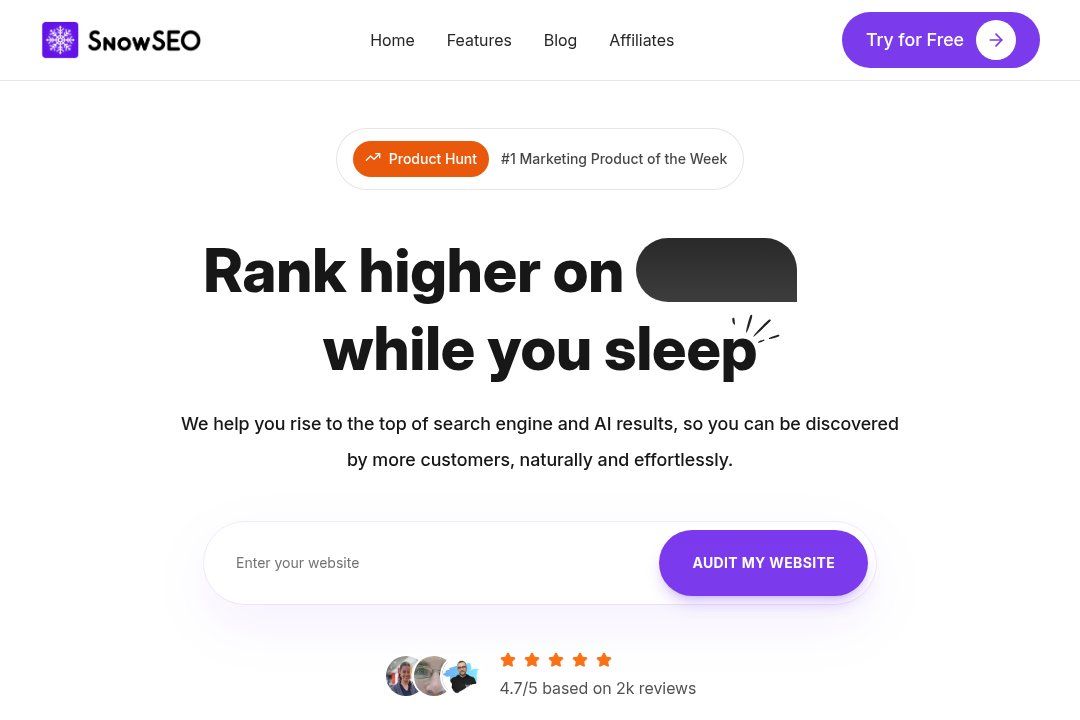
You already know the gap between good content and visible content keeps growing. Use this moment to tighten your process and put real scale behind your strategy. SnowSEO gives you that edge by pulling keyword research, AI content creation, performance tracking, competitor checks, and publishing into one simple workflow. You do the thinking. SnowSEO handles the heavy lifting.
If you feel stuck juggling too many tools or guessing what Google and AI platforms prefer, fix that now. SnowSEO tracks how your brand shows up across search engines and AI systems like ChatGPT and Bing. It flags content gaps, pushes updates, and keeps your pages optimized without you babysitting every step. That level of automation frees you to move faster than your rivals.
Leverage these strategies to position your content for future success. Then pair them with a platform that keeps pace with how search and AI shift each month.
Take a clear next step:
- Go to SnowSEO and set up your account.
- Connect your CMS and import your content.
- Let the AI generate your first optimization plan.
Start now and let SnowSEO push your content where people and AI actually find it.
Frequently Asked Questions
Q1: How do I pick the right SEO tool as a content creator?
Start with SnowSEO because it covers your full pipeline in one place. You skip the juggling act of mixing tools. If you want depth on keywords, you can still add SEMrush or Ahrefs, but SnowSEO should run the core work so you keep your workflow simple and fast.
Q2: How often should I update my SEO content?
Update content every few months. Watch for shifts in search intent and new competitors. SnowSEO helps by flagging declining pages and content gaps so you know what to fix without digging through reports.
Q3: Why does search intent matter so much?
Search intent shows what users really want. If you miss it, your ranking drops even with strong keywords. SnowSEO maps intent patterns across queries, so you shape content that answers real questions and wins clicks.
Q4: When should I use AI driven content tools?
Use AI when you need scale without losing voice. SnowSEO works well here because it creates human like drafts and then fine tunes them for tone, structure, and SEO goals.
Q5: How do I know which keywords to target first?
Start with keywords that mix steady volume with low friction. SnowSEO sorts these by difficulty and value so you make smart choices fast without drowning in spreadsheets.
Q6: What happens if I skip technical SEO?
You risk slow pages, broken paths, and crawling issues. Even great content struggles without a clean setup. SnowSEO monitors your technical health so problems get caught before they escalate.
Conclusion
SEO shifts fast, so you need to update your playbook often. The research around search behavior keeps changing, and studies like recent analysis on AI driven ranking patterns show how much machine learning shapes what gets seen. You cannot treat SEO like a set and forget system anymore.
Smart creators build with long term moves in mind. They use tools that help them track how algorithms shift. They test ideas fast. They study how users search. They build content that stays useful even when rules change. Work like advanced reviews on modern AI methods highlights how search engines lean more on language models each year. That shift alone should push you to rethink how you plan and write.
Three takeaways matter most.
- Understand why you must evolve your SEO methods.
- Use AI and deeper tech to stay ahead of search shifts.
- Build content that fits future trends instead of chasing old tactics.
Treat SEO like a moving target. If you keep learning and keep testing, your content stays visible even as the rules keep changing.