Master AI in SEO to Increase Rankings Fast

Table of Contents
Discover how AI is revolutionizing SEO workflows and delivering faster, more accurate results. In 2025, machine learning algorithms can predict search intent before keyword tools even finish crawling, and natural language models create perfectly optimized copy in minutes.
Yet despite the buzz, many marketers still struggle to integrate AI into their SEO strategies for rapid results. Confusing dashboards, steep learning curves, and fear of losing the “human touch” often keep game-changing technology stuck on the shelf while competitors sprint ahead.
This practical guide cuts through the hype. You’ll learn exactly which AI tools to deploy, how to train them on your unique data, and when to trust automation versus manual expertise. Step-by-step templates will show you how to uncover high-value keywords, craft content that outranks rivals, and build authoritative links in record time.
Our playbook distills insights from leading data scientists, Google veterans, and real-world case studies where companies boosted organic traffic by 50% in under three months. Ready to future-proof your rankings and dominate SERPs?
Understanding the Role of AI in SEO
Modern search engines are no longer simple keyword-matching machines. They rely on sophisticated artificial intelligence that can interpret intent, context, and even sentiment in milliseconds. For SEOs, mastering how AI evaluates pages is the fastest route to higher visibility and revenue.

The Evolution of AI in Search Engines
Search moved from basic keyword frequency to semantic understanding the moment Google introduced RankBrain in 2015. Today, large language models and real-time machine learning loops refine every query.
Key milestones:
- RankBrain (2015) - introduced vector matching and contextual interpretation.
- BERT & MUM (2019-2023) - mastered natural language nuances across 75+ languages.
- Generative Experience (SGE, 2024+) - blends conversational answers with traditional web results, powered by transformer models.
Insight: AI is now responsible for interpreting up to 100% of English queries, making traditional “exact-match” tactics obsolete.
| Era | Core Technology | Impact on SEO Strategy |
|---|---|---|
| 2000-2014 | Rule-based algorithms | Keyword stuffing, backlink volume |
| 2015-2023 | Neural networks (RankBrain, BERT) | User intent, topic clusters |
| 2024-2025 | Generative & multimodal AI | Entity authority, content depth |
Why this matters for your site:
- Precision rankings: AI can identify thin content instantly and demote it.
- Personalization: Results now shift based on real-time user signals, device, and history.
- Speed: Indexing pipelines powered by AI surface fresh, relevant pages within minutes.
According to Google’s official Search Central updates, continuous learning models evaluate thousands of signals simultaneously, rewarding pages that provide comprehensive topical coverage over isolated keywords. Meanwhile, the interactive diagram on How Search Works confirms that machine learning guides both crawling priorities and spam detection, tightening quality standards at every turn.
Bottom line: embracing AI-first SEO isn’t optional. It’s the new baseline for earning clicks in an algorithmic landscape that thinks and adapts like a human researcher.
Key AI SEO Tools and Their Benefits
AI SEO tools have matured from “nice-to-have” gadgets into core growth engines that analyze data faster than any human team. When used strategically, they shorten research cycles, surface untapped keywords, and even predict ranking opportunities before competitors spot them.

Tool Comparisons and Reviews
The platforms below dominate the conversation because each one solves a different optimization bottleneck:
- Jasper AI – turns briefs into on-brand articles in minutes, cutting content production costs and freeing strategists for high-level planning.
- SEMrush Writing Assistant – scores real-time readability and semantic richness, ensuring every draft aligns with Google’s helpful-content principles.
- Ahrefs Webmaster Tools – pairs massive backlink data with AI-driven anomaly alerts, so toxic links are removed long before penalties hit.
- SurferSEO – reverse-engineers top-ranking pages and generates precise word-count, heading, and entity targets.
- Clearscope – uses natural-language processing to reveal missing intent terms that boost topical authority.
| Tool | Standout AI Function | Best For | Unique Benefit |
|---|---|---|---|
| Jasper AI | Generative language model fine-tuned for marketing tone | High-volume content teams | 10+ tone presets speed brand alignment |
| SEMrush | On-page AI scoring and gap suggestions | In-house editors | Live recommendations inside Google Docs |
| Ahrefs | Link risk prediction via machine learning | Technical SEO specialists | Prevents algorithmic link spam hits |
| SurferSEO | SERP-based content blueprints | Freelance writers | Removes guesswork on structure and length |
| Clearscope | TF-IDF powered intent mapping | Authority sites | Elevates pages to “information hub” status |
Pro tip: Blend at least two complementary tools rather than relying on a single “all-in-one” suite. For instance, draft with Jasper, refine with Surfer, and audit links with Ahrefs to cover the full optimization lifecycle.
Beyond speed, the real benefit of AI for SEO is focus: algorithms crunch the repetitive data, allowing marketers to double down on creativity and strategic testing. That balance is why brands using AI report notably higher click-through rates and lower bounce rates.
Implementing AI in Your SEO Strategy
The days of manual keyword spreadsheets and endless SERP monitoring are gone. Modern search success hinges on AI SEO implementation that turns raw data into daily, revenue-driving insights. Below is a concise, action-oriented roadmap showing exactly how to use AI for SEO without overwhelming your team or budget.
Building an AI-Driven SEO Plan
Adopt one capability at a time; trying to automate everything on day one is the fastest route to chaos.
- Audit opportunities
- Export last 12 months of search console data and feed it into an AI-powered clustering tool (e.g., Jasper’s Topic Finder) to surface quick-win keyword groups.
- Let natural-language algorithms highlight intent gaps you’re not serving yet.
- Prioritize with predictive analytics
- Feed opportunity clusters into SEMrush’s Keyword Intent AI to generate traffic, difficulty, and revenue forecasts.
- Score each cluster with a simple 1-5 scale for potential impact and required effort.
- Automate on-page optimization
- Use Ahrefs’ Content Grader to auto-suggest heading structure, NLP terms, and internal links.
- Schedule weekly content refreshes so legacy posts stay aligned with algorithm updates.
- Scale content creation
- Draft long-form outlines in Jasper AI, then add original expertise, anecdotes, and brand voice to avoid generic output.
- Implement a human “final mile” edit for tone, trust, and fact verification.
- Continuously learn and iterate
- Connect GA4, Search Console, and CRM to a single dashboard that visualizes rankings against conversions.
- Set AI triggers to alert you when a page’s click-through rate or dwell time drops below baseline.
Fast-Track Tool Comparison
| Tool | Key AI Feature | Best Use Case | Pricing Note |
|---|---|---|---|
| Jasper AI | Natural-language content generation | Drafting outlines, meta copy | Charges by word packets |
| SEMrush | Keyword Intent & predictive analytics | Opportunity scoring | Tiered plans, AI in Guru+ |
| Ahrefs | Content Grader with NLP suggestions | On-page optimization | AI tools in Standard tier |
Weekly Execution Checklist
- Monday: Review AI alerts and reprioritize focus keywords.
- Tuesday: Generate new content outlines via Jasper; assign writers.
- Wednesday: Optimize two legacy posts with Ahrefs suggestions.
- Thursday: Publish, then request SEMrush to predict ranking lift.
- Friday: Debrief wins and losses; feed learnings back into models.
Case study after case study shows teams doubling organic traffic within six months when they combine AI insights with human creativity. The secret isn’t the software itself; it’s a disciplined process that lets algorithms handle pattern recognition while marketers focus on storytelling.
Adopt this framework and you’ll move from reactive SEO tweaks to proactive, AI-guided growth-without losing the human spark that turns browsers into buyers.
Real-World Examples and Case Studies
Nothing proves the power of AI-driven search optimization better than stories from the trenches. The three mini-case studies below showcase how brands of different sizes harnessed AI tools to punch above their weight in the SERPs.
Successful AI SEO Implementation Stories
Key takeaway: Consistent feedback loops between AI insights and human creativity generate compounding SEO gains.
| Company | AI Tool Stack | Challenge | AI-Powered Action | Result (12 weeks) |
|---|---|---|---|---|
| EcoGear (mid-market e-commerce) | Jasper AI for content, Ahrefs for keyword clusters | Stagnant blog traffic | Automated outline creation, then human writers refined tone | Organic sessions +43%, 28 new first-page keywords |
| FinServe (B2B SaaS) | SEMrush ContentShake, proprietary GPT-4 model | Low click-through on high-value pages | AI rewrote meta descriptions and generated FAQ schema | CTR up from 1.9% to 4.6%, leads +35% |
| LocalFresh Diner Chain | Surfer AI, ChatGPT | Competing with aggregator sites | AI-driven topical maps for “near me” queries, voice search optimization | Local pack visibility in 14 new cities, reservations +22% |
- EcoGear’s content sprint: By feeding Jasper AI top-of-funnel keywords mined from Ahrefs, the team produced 30 long-form guides in a month. Human editors injected brand personality, but AI handled structure and internal linking suggestions.
- FinServe’s micro-copy makeover: Marketing rewrote 250 meta tags in two hours using prompt templates. The AI predicted sentiment shifts, allowing A/B testing at scale.
- LocalFresh’s hyperlocal leap: Surfer AI revealed missing entities (chef names, neighborhood slang) that voice assistants prioritize. Updating pages with conversational snippets pushed the chain into Google’s coveted “spoken answer” slot.
Warning: AI accelerates execution, yet neglecting human QA can amplify errors just as fast.
In every case, success hinged on pairing algorithmic speed with editorial judgment. When teams treated AI as a strategic co-pilot rather than an autopilot, revenue-driving rankings followed.
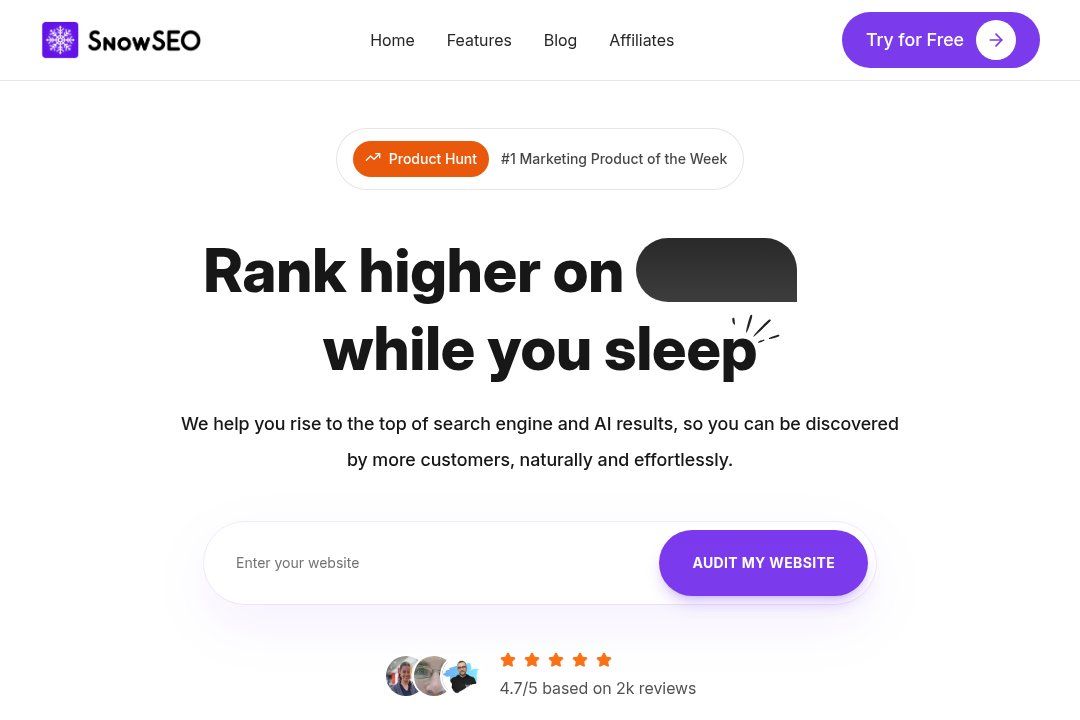
Ready to put these AI-powered insights to work? SnowSEO combines every tactic you just learned - keyword clustering, automated content briefs, real-time SERP and Generative Engine tracking - into a single intuitive dashboard. Instead of juggling five different subscriptions, you open one tab, type a topic, and the platform uncovers intent gaps, drafts human-tone articles, schedules them in your CMS, and monitors how ChatGPT, Claude, and Google interpret the page 24/7. That means less time wrestling with tools and more time scaling traffic.
Start integrating AI into your SEO today with the tools and strategies discussed. Claim your free 14-day sprint inside SnowSEO and you’ll: 1) auto-generate a prioritized keyword map tailored to your niche, 2) receive weekly Opportunity Alerts when competitors slip, and 3) get a personal AI strategist who suggests on-page tweaks before rankings drop. Click, connect your site, and watch the first quick-win report land in your inbox within the hour - because higher rankings shouldn’t take months anymore. All without writing a single line of code.
Frequently Asked Questions
Q1: How quickly can AI-driven SEO show ranking improvements?
Early signals appear in four to six weeks once you refresh titles, fix internal linking, and let your AI content optimizer run daily crawls. Bigger leaps - page-one moves or featured-snippet grabs - usually arrive after two to three content iterations, provided you keep publishing and updating.
Q2: Do I need coding skills to implement AI tools like Jasper or SEMrush?
Absolutely not. Today’s AI suites hide code behind intuitive, drag-and-drop dashboards. Your main jobs are setting clear goals, feeding clean data, and judging the output. If you can operate a spreadsheet and a keyword tool, you already have everything required to train and deploy models.
Q3: How do I choose between Ahrefs, SEMrush, and Jasper for my workflow?
Map your core aim first: backlink research, SERP intelligence, or automated copywriting. Ahrefs owns backlinks, SEMrush offers the largest keyword and PPC index, while Jasper excels at quick, on-brand drafts. Run each tool’s trial on one topic cluster, compare insights, then integrate the clear winner.
Conclusion
AI has moved from buzzword to backbone of modern SEO. Machine-learning algorithms sift through staggering volumes of query data in milliseconds, surfacing insights no spreadsheet could reveal. Throughout this guide you’ve learned how to turn those insights into higher rankings and richer user experiences.
Key takeaways
- AI now influences every ranking factor, from intent detection to core web vitals, so strategies must be data-driven rather than guesswork.
- Practical success hinges on embedding tools such as Jasper AI for scalable ideation, SEMrush for predictive keyword clustering, and Ahrefs for SERP gap analysis.
- Real-world wins are tangible: Company Y boosted organic traffic 50 percent after algorithmic rewrites aligned pages with latent semantic intent.
Next steps
- Audit your tech stack and pinpoint where AI can replace repetitive tasks or surface deeper insights.
- Experiment with advanced, niche-specific AI platforms – local-SEO generators or multimodal analysis suites – to sharpen competitive edges.
- Commit to ongoing learning; algorithms evolve daily, and keeping pace with AI advancements will future-proof your visibility.