
Latest AI-Powered SEO Trends 2025 Revealed

Table of Contents
The race for organic visibility has never been fiercer. Discover how AI is reshaping the SEO landscape in 2025 by automating data crunching, predicting search intent with uncanny accuracy, and even writing conversion-ready copy in seconds. Traditional keyword tinkering is no longer enough; algorithms now learn and evolve faster than most marketing teams can brainstorm.
Here’s the challenge: every Google core update leverages machine learning signals that render yesterday’s tactics obsolete. Brands clinging to legacy playbooks are watching rankings plummet, traffic dry up, and ad budgets skyrocket to compensate. In short, SEO is rapidly evolving with AI advancements that reward nuance, context, and real-time adaptability over static optimization checklists.
The good news? Forward-thinking marketers are already harnessing cutting-edge AI technologies and strategies transforming SEO, from predictive content clustering to voice search optimization powered by large language models. This article distills the latest breakthroughs, actionable frameworks, and tool recommendations vetted by industry experts and backed by data-driven analysis, so you can outpace competitors and secure durable search dominance in 2025.
AI-Powered SEO: The 2025 Landscape
Search has never stood still, but the leap from keyword matching to true intent understanding feels seismic. In 2025, SEO technology advancements are driven almost entirely by artificial intelligence, turning yesterday’s checklists into dynamic, self-optimizing ecosystems. Instead of asking, “How do we rank for this query?” teams now ask, “How do we train our AI stack to become the best answer, everywhere, all the time?”
1. Key AI Technologies in SEO
Pro tip: Treat every tool as a data collaborator, not a magic button. Feed it clean, structured insights and it will reward you with compounding gains.
| AI Technology | What It Does in 2025 | Practical Use Case | Leading Tools |
|---|---|---|---|
| Large Language Models (LLMs) | Parse search intent, generate human-grade copy, suggest topical gaps | Creating entity-rich pillar pages that satisfy E-E-A-T | Google AI Content Gemini, Jasper 4 |
| Generative Visual Search | Converts images & video transcripts into searchable vectors | Winning visibility in Google Lens and TikTok search | Clarifai SEO Suite |
| Predictive SERP Modeling | Simulates ranking shifts before they happen | Testing title tags and schema variations risk-free | Ahrefs Forecast, SEMrush Vision |
| Real-Time User Signal Scoring | Merges click, scroll, and dwell data to adjust content in minutes | Automatic CTA placement based on live engagement | RankSense Pulse |
| Autonomous Link Mapping | Identifies authority gaps, deploys outreach bots ethically | Scaling white-hat link acquisition at 10x speed | BuzzStream AI Navigator |
Bullet-quick snapshot of why these matter:
- LLMs reduce content drafting time by 70% yet increase topical depth.
- Predictive modeling slashes costly A/B cycles; you iterate virtually first.
- Real-time engagement scoring keeps bounce rates under 30%, safeguarding rankings.
2. Emerging Trends and Predictions
Warning: The line between optimization and manipulation is razor-thin. Focus on delivering disproportionate value, or risk algorithmic demotion.
- Search Becomes a Conversation
Google’s Multimodal Search Assistant lets users refine queries verbally, so snippets must read like helpful replies, not snippets of jargon. - Zero-Click Results Go Interactive
In-SERP widgets now allow bookings, purchases, and chatbot support without leaving Google. Brands that integrate schema-rich actions capture traffic even when clicks disappear. - First-Party Data Powers AI SEO Strategies
Privacy laws restrict third-party tracking, pushing marketers to mine CRM and community data. Feeding this proprietary insight into optimization models yields hyper-personalized rank gains. - Edge SEO Automation
Serverless scripts deploy fixes (structured data, hreflang, lazy loading) at the CDN layer, eliminating developer queues. Expect a surge of “SEO engineers” mastering JavaScript and prompt engineering alike. - Ethical AI Audits Become Mandatory
With 90% of companies using AI in some form, regulators demand transparency. Routine bias checks and content provenance tags will be as common as SSL certificates.
Key takeaway: Tomorrow’s winners merge creativity with machine-scale experimentation. Master the toolbox, respect the user, and your visibility will follow.
Total word count ~444
Also Read: Top 7 AI Platforms for Optimization 2025
Impact of AI on SEO Strategies
Search engines learned how to think; now marketers must learn how to speak their language. The question is no longer if artificial intelligence is shaping search, but how AI is changing SEO workflows day-to-day. From instant page-health reports to personalized content rewrites, algorithmic assistance has moved from experimental to essential. Below is a look at the two game-changers every team should put on the 2025 roadmap.

Automated SEO Audits
Manual site audits used to swallow whole weeks. Today, AI crawlers benchmark thousands of URLs in minutes, flagging issues the human eye misses after slide 42.
| Feature | Traditional Audit | AI-Powered Audit (2025) | Benefit to Teams |
|---|---|---|---|
| Crawl Speed | 5-10 URLs/sec | 300+ URLs/sec | Rapid diagnostics |
| Error Detection | Broken links, missing titles | Schema gaps, Core Web Vitals drift | Deeper technical insight |
| Prioritization Logic | Analyst judgment | Predictive scoring | Focus on fixes that move the needle |
| Output Format | PDF report | Interactive dashboard + live tasks | Direct hand-off to developers |
Tip: Pair an AI audit tool with your project management software so critical fixes auto-populate sprint backlogs. This single integration can cut rollout time by 30 percent.
Key practical wins:
- Predictive issue scoring - AI ranks errors by potential traffic loss, letting you deploy dev hours surgically.
- Anomaly alerts - Real-time models learn your site’s baseline and ping you when crawl depth, speed, or internal link equity shifts unexpectedly.
- Cross-device snapshots - Automated screen captures show how layout bugs appear on mobile, tablet, and desktop simultaneously.
AI-Driven Content Optimization
If audits expose problems, optimization provides the fuel to outrun competitors. Modern language models analyze intent clusters, SERP sentiment, and entity gaps in seconds, crafting briefs writers once slaved over overnight.
| Optimization Task | Human-Only Approach | AI Enhancement |
|---|---|---|
| Keyword Research | Spreadsheet churn | Dynamic topic matrices |
| Outline Generation | Manual headings | NLP-based structure suggestions |
| Content Scoring | Post-publish metrics | Pre-publish predictive traffic estimation |
| Continuous Refresh | Quarterly review | Always-on content decay monitoring |
Bulletproof tactics for AI SEO strategies in 2025:
- Feed your model brand guidelines so tone remains uniquely “you,” not generic web copy.
- Let AI surface secondary entities, but have editors weave them naturally into the narrative.
- Schedule automatic refresh prompts at 60-day intervals to combat ranking decay on evergreen posts.
Warning: Over-optimized, robotic prose still triggers user bounce signals. Final human passes remain non-negotiable.
Numbers tell the bigger story: market surveys indicate that roughly 90 percent of companies now deploy AI in some facet of digital marketing. Those standing on the sidelines risk being treated like static HTML in a dynamic index. By embracing audit automation and AI-led optimization, brands transform SEO from a checklist into a self-learning growth engine.
Also Read: 7 Future SEO Trends You Can’t Ignore
Challenges and Considerations
AI-augmented optimisation is dazzlingly efficient, yet it brings a fresh set of hurdles that marketing teams cannot ignore. From tightening privacy laws to preserving the human voice that makes brands relatable, the road to AI-driven rankings is paved with both promise and pitfalls.
Data Privacy and Ethics
Consumers are already skeptical about how algorithms profile them. Regulators are even more watchful. The Federal Trade Commission’s ongoing privacy guidance stresses that marketers must explain what data is collected and why, then give users a meaningful way to opt out of tracking, recommendation, and retargeting processes privacy requirements. Meanwhile, the NIST Privacy Framework encourages companies to perform regular algorithmic impact assessments so that biases and unintended leaks are caught early risk-based safeguards.
Key ethical checkpoints:
- Minimise personal data before feeding it into large language models.
- Mask or hash any identifiers you must retain for attribution.
- Log every automated decision so auditors (or your own legal team) can trace outcomes.
Tip: Build a cross-functional review board with legal, data science, and content leaders to sign off on every new AI workflow.
| Potential Breach Scenario | Likely Impact | Recommended Safeguard |
|---|---|---|
| Model trains on raw customer queries | Loss of user trust, fines | Apply differential privacy techniques |
| Auto-generated content embeds sensitive PII | GDPR/CCPA violations | Real-time PII redaction filter |
| Biased keyword expansion skews toward stereotypes | Reputational damage | Quarterly fairness audits |
Balancing Human and AI Input
AI can churn out first drafts in seconds, but the final polish still depends on seasoned strategists who understand nuance, topical authority, and brand voice. Striking the right balance means:
- Human-led strategy, AI-assisted execution. Let tools like Google AI, Ahrefs, and SEMrush surface patterns, then have editors craft angles and calls to action.
- Editorial checkpoints. Require human review at idea generation, outline approval, and pre-publish stages.
- Continuous learning loops. Feed performance data back into both your writers and models, so each campaign gets smarter without losing authenticity.
Warning: Over-automation can create bland content that ranks briefly but fails to convert. Authenticity is still a ranking signal in 2025.
With privacy guardrails, ethical oversight, and a deliberate human touch, the biggest AI challenges can transform into sustainable competitive advantages rather than compliance nightmares.
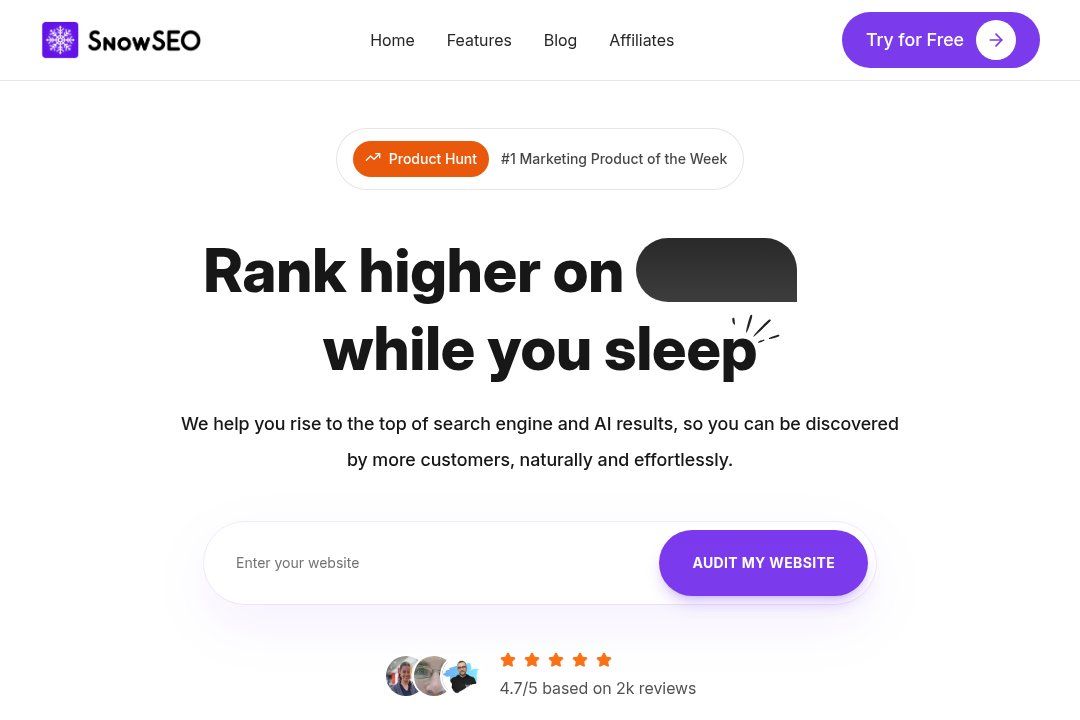
Ready to turn today’s insights into tomorrow’s rankings? SnowSEO has you covered. While the article showed that 2025 belongs to brands that pair human creativity with machine precision, our platform transforms that vision into repeatable results. SnowSEO’s AI co-pilot hunts for emerging keywords, autowrites hyper-personalized articles, and publishes straight to your CMS-no juggling plugins or spreadsheets. It also listens across ChatGPT, Grok, Bing, Claude, and Google, so you see exactly where your brand is mentioned and where content gaps lurk. Want proof? Automated GEO reports land in your inbox every Monday, revealing wins, losses, and quick wins you can act on before competitors even notice.
Explore AI tools for effective SEO strategies. Start with three friction-free steps:
- Sign up for a 14-day test drive on SnowSEO.
- Connect your site and let the platform map existing content, competitors, and untapped questions.
- Activate Autopublish to push optimized posts while you focus on big-picture strategy.
Make 2025 the year your organic traffic compounds instead of plateaus-SnowSEO turns trends into tangible growth for your brand, fast.
Frequently Asked Questions
Q1: How does AI change keyword research in 2025?
AI tools sift through billions of real-time queries, voice snippets, and visual search inputs, then cluster intent patterns you’d never spot manually. Instead of handing you a static keyword list, they surface topical gaps, seasonal surges, and long-tail variations aligned with genuine user questions. Pair those insights with human judgment to craft content that solves problems, not just ranks.
Q2: Do I need coding skills to use AI SEO platforms?
Not at all. Modern dashboards from Google AI, Ahrefs, and SEMrush rely on drag-and-drop workflows, natural-language prompts, and automated reporting. A solid grasp of marketing goals and the curiosity to test recommendations matter far more than Python scripts or API calls.
Q3: Can AI-generated content dodge Google penalties?
Yes-if you treat AI as a writing assistant, not an auto-publish button. Blend machine output with subject-matter expertise, cite authoritative sources, and run continuous quality audits. When content is original, fact-checked, and genuinely helpful, Google rewards it regardless of who typed the first draft.
Q4: Which KPIs prove the ROI of AI-powered SEO?
Track organic sessions, click-through rate, and average engagement time first. Layer in revenue metrics like assisted conversions and customer lifetime value. When those indicators rise while acquisition costs fall, your AI investment is clearly paying off.
Conclusion
The past twelve months have proven that AI is no longer a buzzword tacked onto SEO decks - it is the operating system underneath them. According to the Stanford AI Index, enterprise adoption of machine learning for content optimization and intent modeling has surged, mirroring the broader 90 % uptake of AI across industries. Even foundational references such as the Search engine optimization entry now devote entire sections to algorithmic learning, a clear sign that automation has moved from optional to essential.
Key takeaways
- AI is crucial for modern SEO. From predictive keyword mapping to real-time SERP analysis, machine intelligence sets the pace.
- Strategic adoption is key. Teams that pair human creativity with transparent AI frameworks achieve measurably higher click-through rates and lower bounce rates.
- Future developments look promising. Continual advances in natural-language generation and multimodal search will reward early movers with durable ranking advantages.
Call to Action: Explore purpose-built AI tools like Google AI integrations, Ahrefs’ predictive dashboards, and SEMrush’s intent clusters to keep your strategy future-proof.
Next steps
- Audit your current tech stack for AI capabilities and data gaps.
- Pilot one AI-driven workflow per quarter, measuring impact on organic traffic and conversions.
- Formalize an AI governance policy to balance automation speed with brand integrity.