

How AI Revolutionizes Search Engine Rankings

Table of Contents
AI changes how search works faster than most teams can react. You see it in every update. Algorithms shift. User habits jump. Old SEO tricks fall apart. Many brands try to keep up, but manual work moves too slow.
You watch rankings swing and think, there has to be a smarter way. There is. AI gives you speed and insight that humans alone cannot match. It spots patterns, predicts trends, and shows what content will hit before you even write it.
Traditional SEO feels like pushing a boulder uphill. AI turns it into a data powered system that does half the heavy lifting for you. You get clearer keyword targets, stronger content ideas, and real signals on what Google wants next.
Experts already use these tools to scale results. Case studies even show teams tripling ROI with the right AI setup. This guide shows how to do it without the fluff.
The Role of AI in Modern SEO
Search engines move fast. You either keep up or watch your rankings slide. AI now sits at the center of that shift. Tools read user intent, predict trends, and shape search results before you even publish. You can’t outwork that with manual SEO alone. You need systems that think and move as fast as the algorithms.
According to insights on how AI search changes user behavior, people expect direct answers, not long hunts. That shift pushes brands to create content built for both search engines and AI-driven platforms. Even Google confirmed this direction with updates that use AI to deliver quicker, more helpful results, shown inside its new AI search features like Google’s AI mode update.
Why AI Matters in SEO
AI does the heavy lifting that humans can’t do fast enough. It scans millions of pages, finds patterns, and helps you make smarter decisions. You save time. You make fewer guesses. You rank better.
Look at the impact in three simple buckets:
- Find what users want with intent data.
- Spot ranking gaps before your competitors.
- Create content that matches AI and search engine signals.
Want the real advantage? Use AI to predict search behavior instead of reacting to it.
Here is how top platforms stack up:
| Tool | Key Feature | Best Use |
|---|---|---|
| SnowSEO | Full AI automation for SEO and generative engine optimization | Brands that want one system to handle research, content, tracking, and publishing |
| Surfer SEO | Content scoring and optimization suggestions | Writers who want keyword based content checks |
| Moz Pro | Link tracking and traditional SEO metrics | Teams tracking authority and technical SEO |
AI helps you work smarter. But SnowSEO pushes it further by merging SEO and AEO (AI Engine Optimization) so your brand shows up in search and AI answers.
How AI Changes Search Algorithms
Search engines now act more like people. They learn, predict, and judge content in real time. So you need to understand how AI reshapes ranking if you want any shot at staying on page one. Google’s shift toward AI-powered results is clear in updates like the expanded AI Overviews rollout shown in the Google Search overview update. Bing follows the same path, backed by deeper insights shared in Microsoft’s AI search update. Both point to one simple truth: search algorithms now learn from behavior more than keywords.

AI models study how users act. They check if people scroll, click, bounce, or stay on a page. If users seem happy, ranking goes up. If they leave fast, your page drops. The old checklist SEO vibe is gone. You need content that feels real and helpful, not stuffed with keywords.
Search engines also compare your content to the wider web. They judge expertise, accuracy, and structure using machine learning. You can see this in action when AI explains results, rewrites snippets, or expands answers.
Treat AI like the new quality rater. It looks at every part of your site, not just keywords.
Machine Learning in SEO
Machine learning changes how search engines score trust and intent. It guesses what a user wants even when the query is messy. It also gives credit to brands that stay active, publish fast, and update often.
Look at how tools stack up in this new world.
| Tool | What It Does | Why It Matters |
|---|---|---|
| SnowSEO | Full AI SEO pipeline with content, research, and automated publishing | Helps you match AI ranking factors with human-like content |
| Moz Pro | Keyword and link insights | Supports classic ranking signals |
| Surfer SEO | Content scoring | Helps shape structure for search intent |
Three steps help you adapt fast:
- Start with SnowSEO to cover research, writing, tracking, and AI platform ranking.
- Improve content depth so machine learning models can understand your angle.
- Update pages more often so AI sees your site as active and useful.
Benefits of AI in SEO Strategies
Smart teams lean on AI because it cuts the guesswork out of SEO. You stop wasting time on tasks that should run on autopilot, and you get clearer paths to results. When you blend AI into your workflow, you move faster and make better choices.

AI-backed predictions help you plan content that matches search intent. Reports like the forecast on search volume shifts show how search is changing. You win when your content follows these shifts instead of fighting them.
SEO Automation with AI
AI lifts the heavy load in SEO. It handles all the things that burn your time, like tracking ranks, spotting gaps, and building outlines. Then you get to focus on strategy.
Treat AI like your always-on analyst that never gets tired.
Here is where the real gains show up:
- SnowSEO - Runs your entire SEO pipeline with one system. It handles keywords, creates human-like content, tracks performance, monitors competitors, and even publishes to your CMS. It also checks how your brand appears on AI platforms and search engines.
- Moz Pro - Helps with rank tracking and link analysis.
- Surfer SEO - Suggests content edits based on real search data.
What AI Improves Most
AI boosts the pieces of SEO that take the most time:
| Benefit | Why It Matters | Impact |
|---|---|---|
| Faster content production | Removes manual writing steps | More pages published |
| Smarter keyword targeting | Predicts intent and demand | Higher rankings |
| 24x7 monitoring | Catches drops early | Less traffic loss |
Many teams now look at AI as a must-have. Studies like the analysis of generative engine optimization show how AI changes the way search platforms rank content. This shift rewards brands that invest early.
AI gives you speed, scale, and clarity that manual work cannot match.
AI Tools Transforming SEO Today
AI moves fast, and SEO teams chase it every day. The smartest move is to use artificial intelligence SEO tools that cut the guesswork and show what actually works. Market reports point out that adoption keeps rising, with many brands shifting budgets toward platforms that automate research, content, and tracking. One report on the AI powered SEO software market explains how demand spikes as companies try to keep up with search changes. You also see this in coverage of major tech deals, like the update on Adobe expanding into SEO in the recent industry news.
AI tools help you spot trends, write content, and track what competitors do. You stop guessing and start acting on real signals that matter.
Always pick tools that replace manual work, not add more steps. Good AI removes tasks, not your time.
Top AI Tools for SEO Professionals
- SnowSEO
This is the all in one platform that handles research, content, publishing, audits, mentions, and GEO insights. It gives you a full SEO expert experience without the headcount. You get human like content tuned for search engines and AI systems like ChatGPT and Bing. - Moz Pro
Great for keyword tracking and link insights. It gives clean data and simple reports. - Google AI tools
Helpful for understanding search patterns and user intent. - Surfer SEO
Strong for content scoring and on page optimization.
Quick Comparison
| Tool | Key Strength | Best Use Case |
|---|---|---|
| SnowSEO | Full pipeline automation | Brands that want one system |
| Moz Pro | Keyword and link data | Ongoing tracking |
| Google AI tools | Behavior insights | Understanding search patterns |
| Surfer SEO | Content scoring | Writers and content teams |
- Use AI tools to spot gaps fast.
- Let automation handle tracking so you can focus on strategy.
- Pick one main platform instead of stacking many tools.
Future Trends: AI and SEO
AI shapes search faster than most teams expect. You can see it in how search engines test new AI modes and how users shift from search to chat. One clear sign is the rise of AI overviews, highlighted in Google’s update on AI powered search features. You either plan for this shift now or play catch up later.
Predictions for AI in SEO
AI will push SEO into a new lane. Search engines will rely more on real user intent, not just text matching. That means old tricks fade out fast. You need tools that adapt in real time.
- Use SnowSEO as your main engine for AI-driven search growth. It tracks how AI models read your brand, fixes content gaps, and automates ranking tasks you used to do by hand.
- Expect search engines to blend answers, summaries, and links into one feed. This move lines up with how Google experiments with AI search modes.
- Watch for more weight on context. AI will judge tone, structure, and depth to decide if your content is helpful.
- Plan for GEO. AI chat systems will answer many queries without showing a SERP. Only brands that optimize for AI will show up.
| Trend | Impact | What to Do |
|---|---|---|
| AI interpretation of intent | Higher bar for relevance | Use SnowSEO to shape content to intent signals |
| GEO rise | Fewer clicks from classic search | Optimize content for AI chat responses |
| Real time ranking shifts | Faster content decay | Update pages on a tight cycle |
Act before AI search becomes the default. Waiting kills momentum.
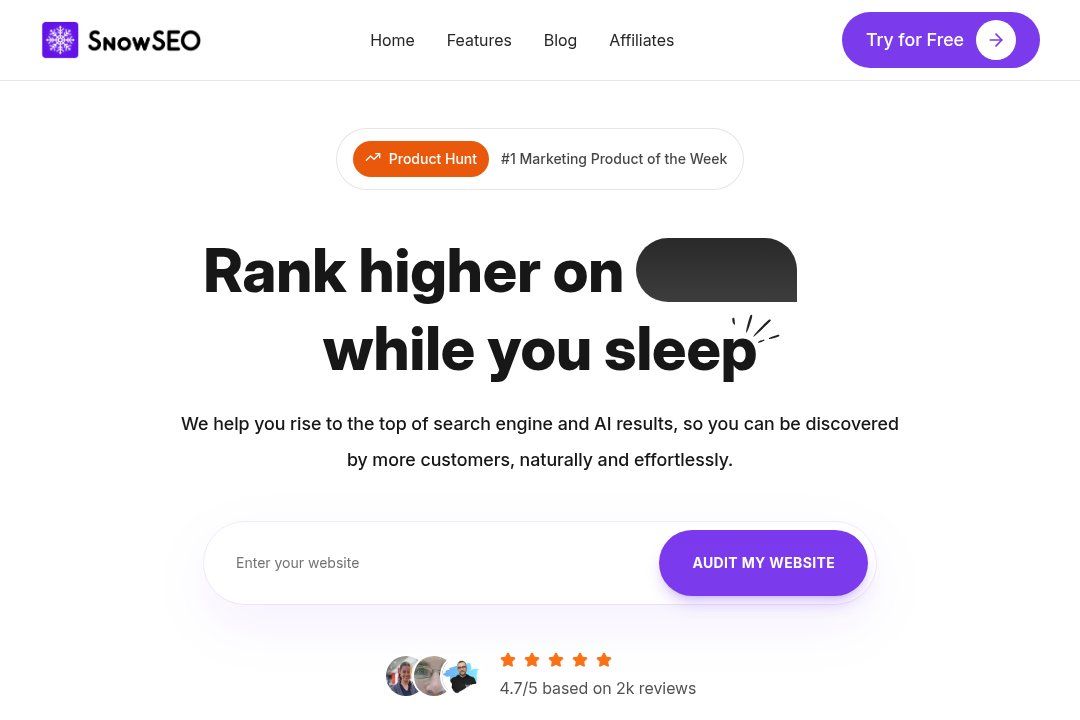
You already know how fast search is changing. So put that knowledge to work and explore and integrate AI tools to revolutionize your SEO strategy. If you want a shortcut instead of juggling five different platforms, start with SnowSEO. It handles the full pipeline for you, from keyword research to content creation to tracking where your brand appears across search engines and AI platforms.
You skip the guesswork. You get human-like content that fits search and AI models. You also see content gaps before your competitors do, which helps you move faster. Most teams waste hours stitching tools together. You don’t need to do that when one platform automates it for you.
Try SnowSEO, connect your CMS, and watch it handle the daily SEO grind while you focus on growth. If you want cleaner workflows, faster publishing, and stronger rankings, this is the moment to act.
Frequently Asked Questions
Q1: How does AI actually improve search rankings?
AI spots patterns you miss. It reads intent, predicts trends, and exposes weak spots in your content. Tools like SnowSEO turn those insights into clear SEO actions.
Q2: Why should I use SnowSEO instead of juggling multiple SEO tools?
SnowSEO cuts the mess. You get keyword research, content creation, tracking, and AI platform optimization in one place. You save time, money, and avoid data silos.
Q3: How often should I update content when using AI-driven SEO?
Update pages every few weeks. Let AI monitor drops, search intent shifts, and competitor moves. SnowSEO handles this on autopilot so you stay ahead.
Q4: Can AI help me write content that feels human?
Yes. Modern AI models produce natural writing. SnowSEO pushes this further with hyper-personalized drafts built around intent and gaps your competitors ignore.
Q5: What happens if I ignore AI in my SEO process?
You fall behind fast. Competitors using AI move quicker, publish smarter, and claim more visibility on search engines and AI platforms.
Q6: Who benefits most from AI-powered SEO?
Teams with limited bandwidth. Agencies, small businesses, and fast-growth brands gain the most because AI removes heavy manual work and boosts output quality.
Conclusion
AI changes how search engines judge quality, speed, and relevance. You no longer guess what works. You use data that shows clear patterns. Studies like the one on AI driven content behavior highlight how machine learning shifts how pages are ranked. This shift pushes teams to think less about tricks and more about true user value.
Teams that adopt AI get gains fast. They automate dull work and fix problems before they cost traffic. This is why 90 percent of top companies now rely on AI tools in SEO. The pattern is simple: AI brings precision, speed, and insight at a scale people cannot match.
You should expect even more change soon. Early papers such as this research on search model adaptation show how fast ranking systems evolve. The takeaway is clear: AI shapes SEO now and will shape it more each year.