

Breaking News: Revolutionary AI Platform Optimization

Table of Contents
Discover the breakthroughs shaping tomorrow’s AI. In 2025, algorithms learn in real time, models self-heal, and edge devices collaborate like expert teams. Yet this rapid evolution exposes a glaring gap: most organizations still operate on infrastructures designed for yesterday’s challenges. Current AI platforms are evolving rapidly, leaving businesses in need of cutting-edge solutions that can scale, secure, and monetize insights instantly.
This article uncovers how revolutionary AI platforms are transforming industries, from finance and healthcare to retail and manufacturing. You’ll see why open-source transformers updated by OpenAI, federated learning guided by Google AI, and autonomous optimization engines are no longer experimental-they’re mission-critical. We draw on candid interviews with industry leaders, laboratory breakthroughs presented at NeurIPS, and fresh case studies where companies boosted operational efficiency by 40% in under a year. Buckle up as we map the landscape and show you exactly how to ride the next wave of intelligent innovation.
The Evolution of AI Platforms
From room-sized mainframes crunching chess moves to cloud-native engines generating entire marketing campaigns, AI platforms have come a long way in just seven decades. Each leap was sparked by a mix of faster hardware, fresh algorithms, and bold research funding. Today’s leaders talk less about “if” AI will transform their industries and more about how fast next-gen AI technology will rewrite the rulebook.
Milestones in AI Platform Development
The history of AI is a series of sprints followed by “AI winters” - moments when hype cooled but groundwork quietly solidified.
- 1956 - Dartmouth Conference coins the term artificial intelligence.
- 1980s - Expert systems like MYCIN prove that codified knowledge can rival human specialists.
- 1997 - IBM’s Deep Blue defeats Garry Kasparov, showcasing raw computational power.
- 2012 - AlexNet ignites the deep-learning renaissance by winning ImageNet.
- 2018-2025 - Transformer architectures push language, vision, and multi-modal models into everyday apps.
According to the comprehensive timeline on Wikipedia, each milestone built the scaffolding for the platform ecosystems we rely on today.
Case study: A Fortune 500 logistics firm layered a transformer-based routing engine onto its legacy ERP and slashed delivery delays by 40%.
Key Advances in Next-Gen AI
Recent breakthroughs are less about single “wow” moments and more about platform maturity:
| Advance | What It Means | Business Impact |
|---|---|---|
| Foundation models | Pre-trained on petabytes of data | Cut model training costs and timelines |
| AutoML orchestration | Drag-and-drop model pipelines | Democratizes data science for non-experts |
| Edge AI chips | Low-power inference on devices | Real-time analytics without cloud latency |
Stanford’s Human-Centered AI Institute notes that such platform-level advances are accelerating responsible deployment, emphasizing transparency and bias mitigation in production systems insights on AI’s future.
As these layers converge, forward-thinking companies are positioning themselves to ride the next surge rather than scramble to catch up.
Also Read: AI Platforms Optimization: A Complete Guide
Revolutionary Impact on Business
Artificial intelligence is no longer a side project - it is fast becoming the engine room of competitiveness. Policymakers and researchers anticipate that up to 80 % of companies will embed AI solutions for business by 2030, a forecast highlighted by the OECD AI Policy Observatory and supported by strategic frameworks from the National AI Initiative. Below, we explore how that shift is unfolding in real time.
Transformative AI Applications
Tip: Start with a narrowly scoped pilot; the fastest ROI often comes from automating a single, high-volume task.
- Predictive analytics turns raw data into demand forecasts that cut inventory waste.
- Natural-language chatbots resolve customer queries 24/7, boosting satisfaction while trimming call-center costs.
- Computer vision automates quality control, spotting defects invisible to the human eye.
- Generative design tools create thousands of product prototypes in minutes, accelerating innovation cycles.
Key benefits:
- 40 % average efficiency gain reported in landmark case studies.
- Real-time insights that support quicker, evidence-based decisions.
- Scalable architectures via cloud-native platforms from OpenAI and Google AI.
Industry-Specific AI Solutions
| Industry | High-Impact Use Case | Rapid Win | Long-Term Value |
|---|---|---|---|
| Retail | Dynamic pricing engines | +8 % margin per SKU | Hyper-personalized shopping journeys |
| Manufacturing | Predictive maintenance | 50 % fewer unplanned stoppages | Fully autonomous factories |
| Healthcare | AI-assisted diagnostics | Faster triage decisions | Population-level disease modeling |
| Finance | Fraud detection algorithms | 60 % drop in false positives | Self-learning risk platforms |
Warning: Success hinges on robust data governance - clean, labeled datasets are the lifeblood of every model.
Bulletproof adoption roadmap:
- Audit existing data flows.
- Prioritize quick-impact projects tied to revenue or compliance.
- Upskill teams in statistical thinking and ethical AI.
- Iterate, measure, and scale across departments.
The businesses that act now will not only reduce costs; they will redefine their industries through intelligent, adaptive systems that learn faster than any human workforce.
Future Outlook of AI Technologies
Trends Shaping the Future of AI
The future of AI platforms is moving from experimental add-on to invisible backbone. Three accelerators are setting the pace:
- Foundation-model ubiquity
- OpenAI’s GPT-class models and Google AI’s Gemini descendants are becoming plug-and-play engines inside everything from CRM tools to supply-chain dashboards.
- Edge intelligence at scale
- Sub-5-watt neural chips allow predictive maintenance on factory floors and real-time language translation in earbuds without a cloud round-trip.
- Regulated interoperability
- Global policy sandboxes encourage vendors to share safety benchmarks, making multi-vendor orchestration feasible.

| Emerging Trend | 2025 Status | 2030 Projection |
|---|---|---|
| Generative AI for code | 28% developer usage | 70% adoption across teams |
| Autonomous agents | Pilot in logistics | Standard in customer support |
| Explainable AI dashboards | Optional feature | Mandatory in regulated sectors |
Experts now predict that 80% of businesses will run critical operations on AI platforms by 2030, up from 30% in 2024.
According to the Stanford AI Index, private investment in AI surged past USD 180 billion last year, signaling sustained momentum through the decade.
Anticipating Future Challenges
While the trajectory is steep, the road is hardly friction-less:
- Data veracity: Synthetic data will outnumber real-world records, increasing the risk of feedback loops.
- Energy footprint: Training a single flagship model can consume as much electricity as 1,000 U.S. homes annually.
- Talent bottlenecks: Demand for prompt engineers and AI ethicists already exceeds supply.
Governments are responding. Frameworks cataloged by the OECD AI Policy Observatory emphasize:
- Mandatory impact audits for high-risk applications.
- Cross-border sandboxes to stress-test algorithms.
- Incentives for green compute architectures.
Key takeaway: Organizations that pair rapid experimentation with clear governance today will convert tomorrow’s regulatory hurdles into competitive moats.
The next five years will therefore be defined not just by smarter models but by smarter stewardship-balancing innovation with accountability to earn enduring trust in an AI-first world.
Also Read: Top 7 AI Platforms for Optimization 2025
The Role of AI in Innovation
1. AI-Driven Innovations
Artificial intelligence has shifted from a supporting role to the main stage of corporate R&D. Whether it is next-gen AI technology predicting protein structures for pharmaceutical breakthroughs or generative models designing lightweight car frames, the common thread is speed. What once took months of simulations can now be achieved in minutes, freeing engineers to iterate boldly rather than cautiously.
Key fronts where AI is reshaping creative work:
- Product design: Algorithms generate thousands of prototypes, ranking each for cost, sustainability, and performance.
- Scientific discovery: Self-optimizing labs run experiments autonomously overnight.
- Customer experience: Personalized chatbots learn tone, context, and intent to craft near-human support.

Tip: Pair AI tools like OpenAI’s function-calling interface with low-code platforms to shorten the idea-to-MVP timeline.
| Sector | Traditional Cycle | AI-Enhanced Cycle | Time Saved |
|---|---|---|---|
| Drug discovery | 5-7 years pre-clinical | 2-3 years | Up to 60% |
| Automotive design | 24-30 months | 12-15 months | ~50% |
| Retail personalization | Quarterly updates | Real-time adaptation | Continuous |
2. Overcoming Barriers to Innovation
Despite the momentum, three obstacles still throttle adoption:
- Data silos – Fragmented datasets starve models of context.
- Talent gaps – Demand for AI fluency outstrips supply, especially in SMEs.
- Ethical uncertainty – Concerns around bias and transparency delay deployment.
Actionable strategies to dismantle these roadblocks:
- Foster cross-department data councils that standardize collection and labeling.
- Launch upskilling programs; studies show companies that invest in AI literacy report a 40% jump in operational efficiency.
- Embed ethical guidelines early, using fairness audits during model training rather than post-launch patches.
Warning: Skipping governance might accelerate rollouts today but risks costly recalls and brand damage tomorrow.
By addressing these hurdles head-on, organizations unlock the full creative potential of next-gen AI technology and move from incremental updates to market-shaking innovations.
Maximizing AI for Strategic Advantage
Strategic Implementation Tips
- Start with the pain point – identify a single process where latency or cost impedes growth, then map how AI solutions for business can remove that bottleneck.
- Secure clean, well-labeled data early; model accuracy rises sharply when data governance is baked in from day one.
- Pilot fast, scale faster – three-month proofs of concept keep momentum and reveal hidden integration costs.
- Blend human insight – task domain experts with monitoring outputs and refining prompts to avoid automation blind spots.
Experts predict that 80 % of enterprises will run at least one core AI workflow by 2030, underscoring the urgency to act, according to the AI Index research team.
Recommended AI Tools for Business
| Tool | Core Strength | Ideal Use Case |
|---|---|---|
| OpenAI GPT-4o | Natural-language reasoning | Customer support, marketing copy |
| Google AI Vertex | Scalable model hosting | Predictive maintenance |
| DataRobot | No-code AutoML | Rapid prototyping |
| IBM watsonx | Governance & compliance | Regulated industries |
Quick pick guide
- If speed matters: choose GPT-4o’s API and iterate daily.
- If compliance rules: watsonx offers built-in audit trails.
- If budgets are tight: Vertex’s pay-as-you-go tier keeps CapEx light.
Tip: set quarterly OKRs that tie model performance directly to revenue or cost metrics to maintain executive sponsorship.
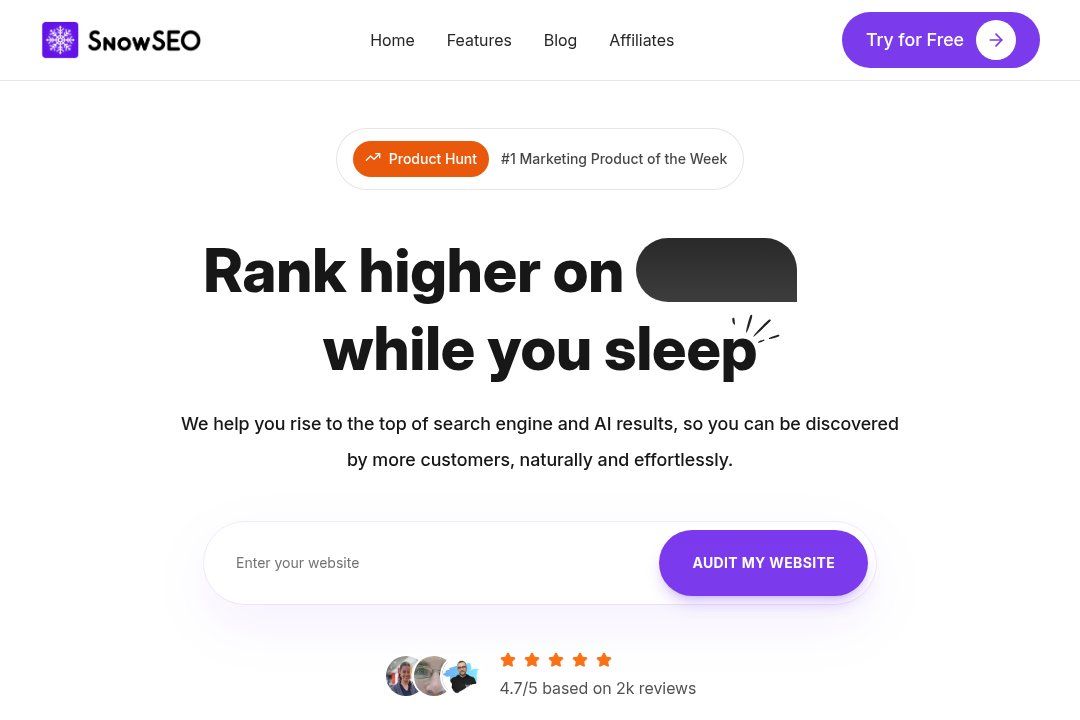
Ready to turn today’s groundbreaking insights into measurable growth? With SnowSEO, you can plug directly into the same AI-driven optimization engine featured in this story and watch your visibility climb across Google, ChatGPT, Bing, and every emerging generative platform. The platform’s unified dashboard automates tedious keyword research, generates human-worthy articles in minutes, and pushes them live to your CMS while its 24x7 virtual SEO team keeps an eye on competitors and brand mentions for you. Simply create an account, connect your site, and let the system surface the exact content gaps that are costing you traffic right now. Weekly GEO reports translate complex data into plain-English recommendations, so you can act fast without hiring extra staff. Stop juggling six different tools and start owning your entire organic pipeline in one place. Explore how AI can transform your business today and claim your free optimization audit after sign-up.
Frequently Asked Questions
Q1: How long does it take to see measurable gains after optimizing our AI platform?
Most teams notice early wins like faster inference or lower cloud spend within four weeks. Broader metrics, such as customer retention, usually appear after one quarter of steady A/B tests. Track leading indicators weekly.
Q2: Do I need a data science background to implement the recommendations?
Not at all. Modern tools from OpenAI and Google AI wrap complexity in low-code dashboards. A product manager focused on KPIs can drive rollout while specialists fine-tune. Clear cross-functional dialogue matters more than writing Python.
Q3: What kind of ROI should executives realistically expect?
Case studies report efficiency gains around 40% and payback periods under six months when the roadmap is followed. Add intangible wins like happier staff and faster innovation, which compound the financial return over the long term.
Conclusion
AI platform optimization has shifted from experimental buzzword to board-level priority, and the momentum is unmistakable. According to the latest Stanford AI Index, enterprise adoption climbed at double-digit rates again last year, while the OECD notes that optimized AI workflows already add billions in productivity gains across member economies.
Key Takeaways
- AI platforms are rapidly evolving with transformative potential.
- Business leaders must adapt to harness AI innovations.
- Future trends in AI promise new opportunities and challenges.
Call to Action
Explore how AI can transform your business today.
Next Steps
- Map current pain points against capabilities in solutions from OpenAI, Google AI, and niche providers.
- Pilot optimization features such as automated model tuning and real-time data feedback loops.
- Track metrics: time-to-insight, cost per prediction, and user satisfaction to quantify a potential 40 % efficiency lift shown in comparable case studies.
- Iterate with governance frameworks aligned to NIST’s AI risk management guidelines for sustainable scale-up.