

AI Secrets: Enhance SEO with Personalization

Table of Contents
Discover how AI-driven personalization can turbo-charge your search visibility and turn casual visitors into loyal customers. In a digital arena where ranking algorithms evolve daily, most marketers still rely on one-size-fits-all tactics that leave valuable traffic untapped. The real obstacle is not the lack of data - it is knowing how to convert torrents of data into hyper-relevant experiences Google loves. That’s where artificial intelligence steps in.
This guide demystifies the process, showing you how to combine Google AI, Moz, and Yoast insights with behavioral signals to build content that resonates on an individual level. You’ll learn to map intent clusters, automate content optimization, and serve dynamic on-page elements that satisfy both users and crawlers. Backed by fresh industry analytics and the practical wisdom of leading AI researchers, each section delivers actionable frameworks you can deploy today. Ready to replace guesswork with precision? Let’s unlock the personalization secrets hiding inside your SEO stack.
Understanding Personalized SEO through AI
Search algorithms in 2025 are less about matching keywords and more about matching intent. Personalized SEO AI enhancements allow your content to adapt in real time to every micro-signal a user sends - location, device history, even preferred reading level. Instead of one static page, you deliver thousands of subtly different experiences that feel handcrafted.
The Role of AI in Personalization
Personalization succeeds when relevance feels like intuition rather than surveillance.
- Data Gathering
- Natural-language processing collects semantic patterns from search queries.
- Computer vision categorizes on-page visuals and maps them to user interests.
- Predictive analytics scores each visitor’s likelihood to convert.
- Segmentation at Scale
AI clusters visitors into intent segments in milliseconds. A returning customer who skimmed pricing tables yesterday instantly sees a comparison chart above the fold, while a first-time reader sees an educational intro. - Dynamic Content Rendering
- Google AI Recommendations API swaps headlines based on sentiment.
- Moz Fresh Web Explorer injects trending examples to keep posts current.
- Yoast’s real-time schema generator adjusts FAQ markup for voice search.
| AI Function | SEO Benefit | User Impact |
|---|---|---|
| Contextual language models | Higher topical authority | Answers feel tailor-made |
| Reinforcement learning | Continuous CTR uplift | Fewer back-button bounces |
| Edge caching personalization | Sub-second load times | Frictionless mobile browsing |
Tip: Combine server-side rendering with AI personalization so search bots crawl a clean, fully rendered version while users receive real-time tweaks.
Bulletproof personalized SEO relies on three pillars:
- Transparent data use - let users know why content changes.
- Ethical frequency - avoid over-personalizing, which can feel creepy.
- Continuous testing - feed outcome data back into the model for refinement.
When these elements align, AI transforms SEO from a static checklist into a living conversation with every individual who lands on your site.
Also Read: Hyper-Personalized SEO Strategies That Work
Techniques for Implementing AI in SEO
Personalization techniques in SEO have moved far beyond “Hello $name.” Today’s AI engines read search intent at scale, learn from live user signals, and reshape on-page elements in real time. Below are field-tested approaches to weave that power into your optimisation stack.

1. AI Tools for SEO Personalization
| AI Tool | Core Personalization Feature | Best-fit Use Case |
|---|---|---|
| Google AI integrations (Search Console Insights) | Real-time intent clustering | Updating headline variants for trending queries |
| Moz Pro with STAT | Predictive rank tracking by persona | Localised landing pages for multi-city brands |
| Yoast SEO Premium | Paragraph-level readability scoring | Dynamic content blocks in CMS templates |
Keep an eye on tool overlap. Running two intent classifiers simultaneously can inflate crawl budgets and slow page delivery.
Step-by-step Implementation Roadmap
- Audit data streams
- Map clicks, scroll depth, and conversion events to individual URL groups.
- Train or fine-tune language models
- Feed anonymised query logs into a small domain model to surface nuanced synonyms.
- Deploy automated content experiments
- Let the AI spin meta descriptions for each cohort, then A/B test against your control copy.
- Close the feedback loop
- Push winning variants back into the model so future recommendations improve continuously.
Quick-fire Personalization Tactics
- Semantic cluster briefs: Auto-generate outlines aligned with long-tail variations.
- Dynamic FAQ injection: Insert questions that match user history or geo-location.
- Sentiment-aware internal linking: Surface supportive articles when reader sentiment dips below a threshold detected in scroll behavior.
Smart teams treat AI as a co-pilot, not a black box. Combine algorithmic insights with human editorial judgment and you’ll ship experiences that feel handcrafted for every visitor-while your competitors are still stuffing keywords.
Benefits and Challenges of Personalized SEO
Personalized SEO powered by AI enhancements reshapes how brands show up in search results. Instead of generic rankings, each visitor receives content tuned to intent, device, and past behavior, creating an experience that feels tailor-made.

Key Benefits
- Deeper engagement - Relevant copy and product suggestions keep users scrolling, boosting dwell time.
- Higher conversion rates - Aligned messaging shortens the decision journey, lifting revenue metrics.
- Improved ranking signals - Lower bounce rates and richer on-page interactions feed Google AI positive quality data.
- Efficient content spend - Dynamic blocks replace one-size-fits-all articles, reducing production waste.
Pro tip: Feed AI models first-party analytics rather than vague demographic buckets. Granular data fuels sharper personalization and avoids content overlap penalties.
Built-In Challenges
- Data silos: CRM, analytics, and CMS often speak different languages.
- Privacy compliance: Tightening regulations demand transparent consent flows.
- Algorithm volatility: Search engines refine personalization factors constantly, so yesterday’s rules age fast.
| Aspect | Benefit | Challenge | Mitigation |
|---|---|---|---|
| User Signals | Higher CTR | Tracking restrictions | Server-side tagging |
| Content Variants | Better relevance | Production overhead | Modular templates |
Overcoming Personalization Challenges
Enterprise teams tame complexity with a mix of process and tech:
- Map every data source, then centralize through a customer data platform before touching SEO logic.
- Build privacy by design - cookie opt-ins, data minimization, and clear value exchanges.
- Schedule monthly audits where SEO leads, legal, and data scientists pressure-test AI outputs.
- Use adaptive testing: let algorithms automatically retire underperforming variants, freeing humans to craft fresh angles.
Staying agile transforms personalized SEO AI enhancements from a maintenance headache into a compounding advantage.
Also Read: Content Personalization: Ultimate Guide to Success
Case Studies of Successful AI-Personalized SEO Strategies
Analyzing Success Stories
Personalized SEO AI enhancements move from buzzword to bottom-line driver when real companies put them to work. Below are three concise case studies that reveal how adaptive algorithms, intent clustering, and real-time content delivery dramatically shifted visibility and revenue.
1. StyleSphere – Fashion E-commerce
- Deployed a recommendation engine that rewrites meta descriptions based on shopper history.
- Result: 38 % lift in organic click-through within six weeks.
- Key Insight: Dynamic snippets outperform static keywords when trend cycles change weekly.
2. CloudFlow – B2B SaaS
- Leveraged predictive journey mapping to surface industry-specific landing pages only to high-intent visitors.
- Result: 27 % drop in bounce rate and a 19 % uptick in free-trial sign-ups.
- Key Insight: Intent scoring lets long-tail pages rank without bloating site architecture.
3. CityPulse Media – Digital Publisher
- Integrated a headline generator that tests sentiment against regional search data before publishing.
- Result: 2.3× growth in featured-snippet wins across 90 days.
- Key Insight: Geo-aware sentiment boosts E-E-A-T signals where local relevance matters most.
Tip: Blend AI tools such as Google AI’s “Search Generative Experience” with established platforms like Moz and Yoast to validate technical health before adding layers of personalization.
| Company | Primary AI Tactic | KPI Improved | Percentage Change |
|---|---|---|---|
| StyleSphere | Dynamic meta descriptions | Organic CTR | +38 % |
| CloudFlow | Predictive journey landing pages | Bounce Rate | −27 % |
| CityPulse Media | Geo-sentiment headline optimization | Featured Snippets Won | 2.3× |
Key takeaways for marketers:
- Start with one data-rich segment; scale once algorithms stabilize.
- Feed continuous feedback loops; stale models dilute gains.
- Quantify success in business terms, not just rankings, to secure C-suite buy-in.
Preparing for Future Trends in AI and SEO Personalization
Strategizing for Future Trends
Search behavior is becoming hyper-contextual. To stay ahead, marketers should weave SEO personalization trends 2025 into every roadmap, not bolt them on later.
Key insight: Algorithms now reward intent clusters, not isolated keywords. Your content architecture must mirror the user journey, not your siloed departments.
- Audit existing data streams. Ensure CRM, analytics, and ad platforms feed into a single customer profile.
- Build micro-segment playbooks. Draft headlines, CTAs, and schema variations for each intent cohort.
- Automate experimentation. Use Google AI, Moz, or Yoast testing suites to A/B SERP snippets in real time.
- Train non-technical teams on prompt engineering so they can iterate without developer bottlenecks.
| Emerging Signal | Why It Matters | Immediate Action |
|---|---|---|
| Search Generative Experience (SGE) overlays | Answers appear before organic links | Optimize FAQs and concise answer boxes |
| Real-time sentiment analysis | Ranks pages matching emotional tone | Update copy weekly using tone scoring tools |
| Multimodal queries (voice + image) | Users combine camera and questions | Add descriptive alt text tied to conversational cues |
- Budget guidance: Reserve 15% of SEO spend for tools that integrate predictive analytics; this cushions you against algorithm volatility.
- Culture shift: Celebrate small wins from micro-tests to nurture a data-first mindset across content, product, and sales teams.
Future-proof brands treat personalization not as a feature but as the operating system of their entire search strategy.
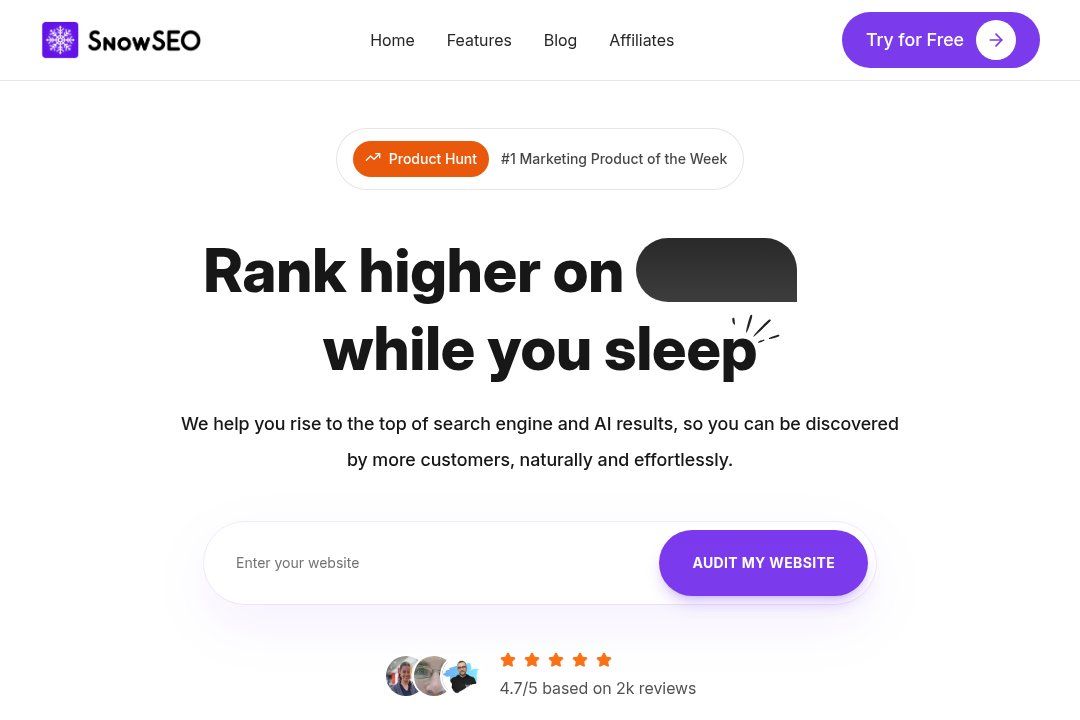
Ready to turn today’s insights into measurable growth? With personalized search signals evolving hourly, successful teams need more than scattered tools - they need a single, AI-native cockpit. SnowSEO plugs directly into your CMS, listens to the same intent data you just learned about, and autogenerates human-sounding pages tailored for every micro-audience. Instead of juggling keyword sheets, drafts, and rank trackers, you get an always-on strategist that discovers content gaps, publishes optimized copy, and reports results before your first coffee. Apply AI techniques in your SEO strategy today: 1) Create your free workspace, 2) import five URLs you want to outperform, and 3) watch SnowSEO map a personalization blueprint in minutes. The platform even monitors how ChatGPT, Grok, and Bing describe your brand so you can influence those answers - no extra dashboards required. Join thousands of marketers who’ve cut tool costs by 60% while doubling organic and generative traffic in 90 days.
Frequently Asked Questions
Q1: How does content personalization actually improve SEO performance?
Personalization boosts relevance scores, so Google’s AI sees your pages as answers for micro-intent. Start by segmenting visitors into intent clusters, then serve dynamic headlines, internal links, and schema that mirror their stage in the funnel. Even small tweaks, like geo-specific examples, can lift click-through and dwell time.
Q2: What’s the smartest way to blend AI tools with human creativity when creating articles?
AI-driven keyword research tools crunch millions of queries and surface latent semantic opportunities humans miss. Feed those terms into content briefs, but refine them with human voice and brand tone. Afterwards, let conversational AI draft outlines, then have a writer enrich with storytelling, citations, and conversion hooks before publishing.
Q3: Which metrics prove that AI-powered personalization is working?
Measure success with a blended dashboard: personalized organic traffic, scroll depth, returning visitor rate, and assisted conversions. Compare cohorts exposed to AI personalization against control groups. If you see statistically significant lifts after four weeks, scale the tactic; if not, iterate on prompts, segmentation logic, or content freshness signals.
Conclusion
Artificial intelligence has shifted from buzzword to backbone of modern SEO. By reading user signals in real time, AI models surface relevant content for each visitor, lifting engagement and conversions.
Key Takeaways
- AI driven personalization closes the gap between search intent and on page experience, boosting relevance scores.
- Tools like Google AI, Moz predictive ranking, and Yoast Insights turn raw data into actionable keyword clusters and content briefs.
- Mixing machine learning forecasts with human creativity future proofs visibility as algorithms evolve.
Call to Action
Apply AI techniques in your SEO strategy today by pairing algorithmic insights with audience empathy.
Next Steps
- Audit analytics pipelines to ensure clean data feeds your chosen AI platform.
- Pilot one personalization feature, such as dynamic meta titles for core pages.
- Document results, refine prompts, and scale winning tactics to stay ahead of emerging SEO trends.